 Zhu's Plant Journal
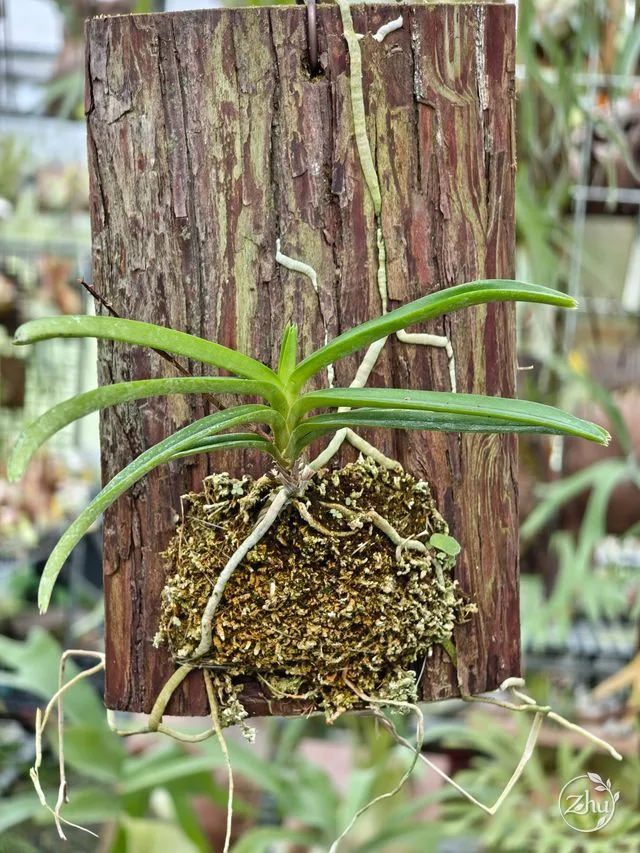
Reading about orchids, you soon run into the terms "monopodial" and "sympodial". They describe the growth habit of an orchid's stem: a single stem that keeps growing upward, or a horizontal stem that produces new stem sections one after another. These are the two main growth types traditionally recognised in the orchid family.
There is more than one way to say this in Chinese. Taiwan's National Academy for Educational Research translates the botanical terms as 單軸分枝 (monopodial branching) and 合軸分枝 or 假軸分枝 (sympodial branching), and Taiwan's orchid industry also uses the term 複莖性 "multi-stemmed", for example describing cattleyas as multi-stemmed epiphytes. On the Chinese side of this site the terms used are 單軸莖 and 複軸莖.
Monopodial: new leaves from the stem tip
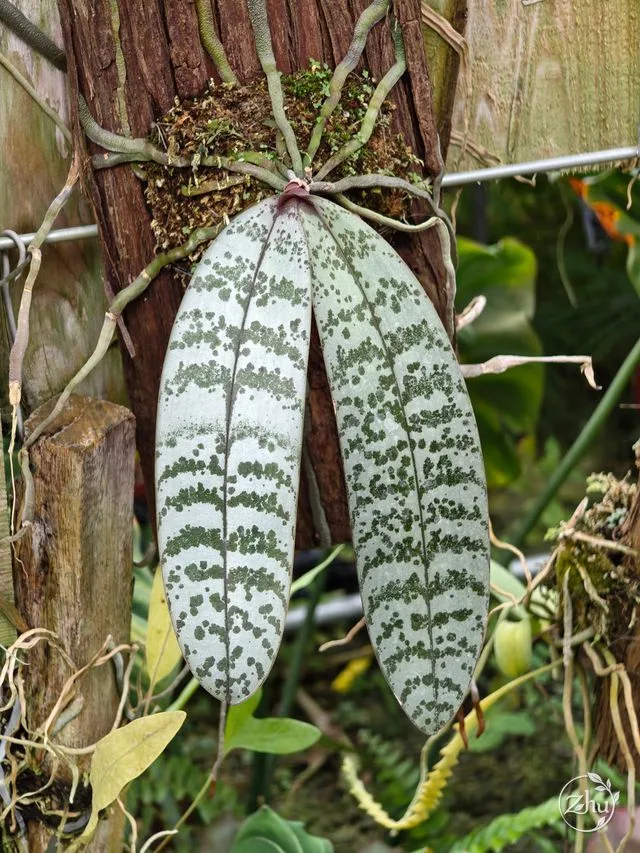
A monopodial orchid generally has just one distinct stem, which produces new leaves from its tip season after season; all new growth comes from that tip. The leaves alternate along the whole length of the stem, and on older plants the lower leaves may drop; roots and inflorescences come from the stem at intervals.
Monopodial orchids have neither pseudobulbs nor rhizomes. Some can grow very tall in the right conditions, such as vandas grown outdoors in the tropics; phalaenopsis stay much lower and more compact.
Within the orchid family, the monopodial habit is found mainly in two groups: the vining species of subfamily Vanilloideae (such as the genus Vanilla), and the mostly epiphytic tribe Vandeae. Phalaenopsis and vandas are both monopodial.
The Vanda miniata in the cover photo used to be placed in the genus Ascocentrum; POWO currently accepts the name Vanda miniata, and it is native to Sumatra, Java and the Malay Peninsula. Phalaenopsis schilleriana is native to Luzon in the Philippines.
Sympodial: growing sideways along a rhizome
A sympodial orchid has a horizontal stem called a rhizome. The rhizome extends sideways and sends up new upright shoots one after another; each new shoot starts at the base of the previous mature one, and each is much like the one before. A plant may make just one new shoot at a time, perhaps only one a year, or several at once.
Each new shoot stops growing once it reaches a certain point, and carries its inflorescence at its tip or on its side. In many sympodial orchids the shoots swell into pseudobulbs, which store water and nutrients. The pseudobulbs at the younger end of the plant are called front bulbs, and those at the older end are called backbulbs.
The sympodial habit occurs in every subfamily of orchids, in both terrestrial and epiphytic species, and most cultivated orchids are sympodial, for example Cattleya, Oncidium, Dendrobium and Cymbidium.
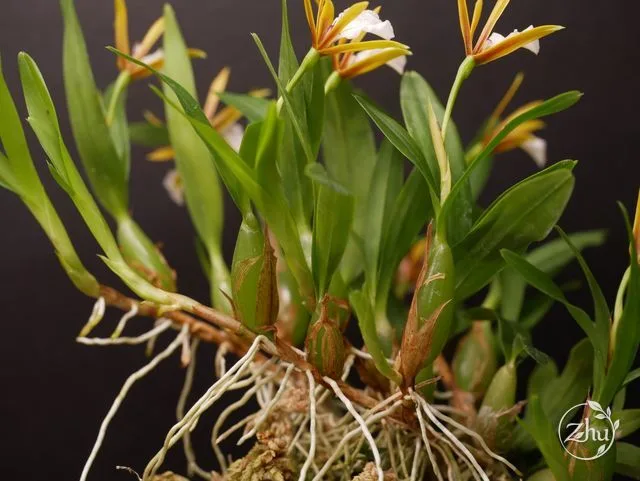
The Dinema polybulbon on this site is sympodial: new pseudobulbs grow one after another and gradually form a clump.
The canes of dendrobiums
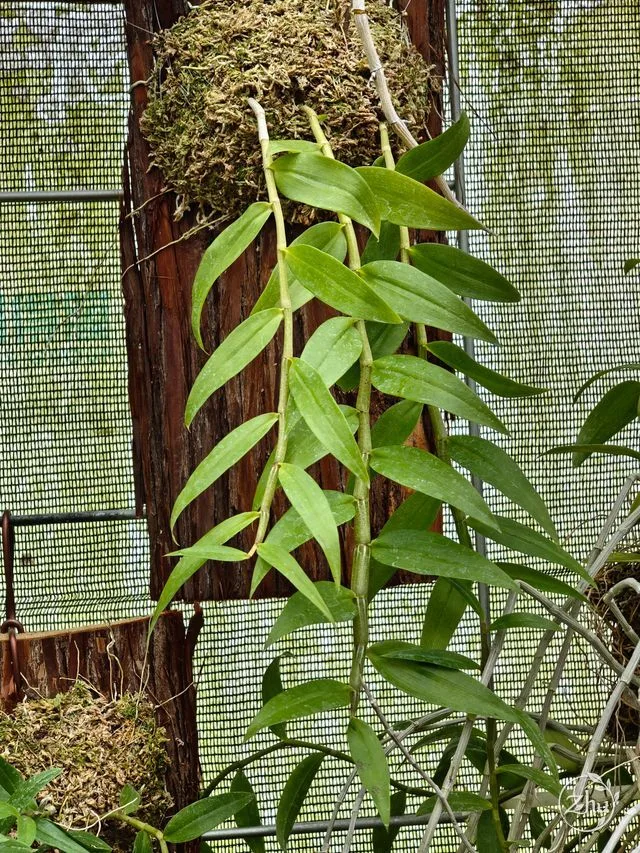
Dendrobiums are a little different. Their stems are slender, more like a stalk than a bulb, and are called canes; they work much like pseudobulbs, also storing water and nutrients.
Dendrobium aphyllum has clustered, pendulous stems 20 to 200 cm long. The leaves last only one growing season before falling, and the inflorescences come from the sides of the previous season's stems, which have already dropped their leaves.
Tolumnia, with no obvious pseudobulbs
At first sight a Tolumnia is just a fan of leaves. Its stems are small, usually completely hidden by the leaf bases, and only sometimes form pseudobulbs. But it does have rhizomes, and new plants grow from short rhizomes, which fits the sympodial growth habit. The genus used to be included in Oncidium, where these plants were known in horticulture as the "equitant" oncidiums.
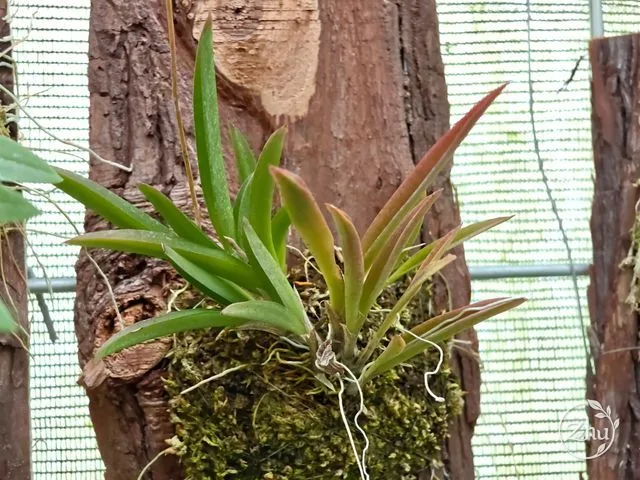
How to tell them apart
| Monopodial | Sympodial | |
|---|---|---|
| Stem | A single distinct stem, producing new leaves from its tip | A rhizome extending sideways and sending up new shoots |
| Where new growth comes from | The stem tip | The base of the previous mature shoot |
| Pseudobulbs | None | Usually; canes in dendrobiums, and small or inconspicuous in some species |
| Examples | Phalaenopsis, Vanda | Cattleya, Oncidium, Dendrobium |
They are propagated differently too
Sympodial: division
Sympodial orchids can be divided by cutting through the rhizome. Before cutting, check two things: that each piece has at least one eye capable of producing a new shoot, and that it has enough pseudobulbs to support that new growth. The traditional recommendation is at least four pseudobulbs per division, especially for cattleyas; a one-bulb division can survive, but its new growth will be small and is unlikely to flower.
Older pseudobulbs that no longer produce new shoots (backbulbs) can also be divided off and propagated, as long as an eye is still alive.
Monopodial: taking the top
Because a monopodial orchid produces new leaves only from its tip, there are far fewer chances to divide it. The traditional method is to cut between the rooted base and the growing tip. Vanda-type orchids often grow roots along the lower half of the stem, so the top section cut from an older plant can come with roots already formed. Phalaenopsis grow slowly, but in time they too may get too tall and need the same treatment.
Once the top has been cut off, the remaining base, if it was vigorous to begin with, may produce one or more new growing points.
Plantlets: keikis
Some orchids grow plantlets from undeveloped buds on their flower spikes or stems, called keikis (in Taiwan they are commonly called 高芽), for example on phalaenopsis flower spikes or dendrobium canes. Once a keiki has roots about 2.5 to 5 cm long, it can be cut off and potted on its own.
Division, top cuttings and keikis are all asexual propagation, so the new plants are genetically identical to the parent (see "Seedlings and vegetatively propagated plants").
Some fall in between
Monopodial and sympodial are the two traditional categories, but not every orchid fits neatly into one of them. A preliminary study of the neotropical genus Maxillaria found that some species are entirely sympodial, with each growth ending in a pseudobulb; some are monopodial without pseudobulbs; and some are sympodial when young and become monopodial as adults. According to this preliminary analysis, the monopodial habit has arisen at least five times from sympodial ancestors.
Orchids on this site
- Monopodial: Phalaenopsis pulcherrima, Phalaenopsis violacea
- Sympodial: Dinema polybulbon
Citations and sources
Sources
- American Orchid Society (AOS): Orchid Parts and Why They Matter
- American Orchid Society (AOS): Allikas, G. (2009) AOS Beginner's Newsletter: Epiphyte or Terrestrial? Sympodial or Monopodial?(St. Augustine Orchid Society 網站轉載 PDF)
- American Orchid Society (AOS): Shoots and Spikes
- Comptes Rendus Biologies(法國科學院): Bonnet, P., Barthélémy, D., Schuiteman, A. & Svengsuksa, B. (2009). Remarkable growth pattern in Chrysoglossum ornatum Blume and observations in related species. Comptes Rendus Biologies 332(1): 15–24
- 國家教育研究院 樂詞網: 學術名詞(生物學名詞-植物):monopodial branching、sympodial branching
- 農業部 農業知識入口網(收錄社團法人台灣蘭花產銷發展協會〈嘉德麗雅蘭〉): 嘉德麗雅蘭(台灣蘭花產銷發展協會「蘭花生活館」頁面 PDF)
- Plants of the World Online (POWO), Royal Botanic Gardens, Kew: Vanda miniata (Lindl.) L.M.Gardiner
- Plants of the World Online (POWO), Royal Botanic Gardens, Kew: Phalaenopsis schilleriana Rchb.f.
- Royal Botanic Gardens, Kew(POWO 收錄之 Kew Species Profiles): Dendrobium aphyllum (Roxb.) C.E.C.Fisch. — General information
- Plants of the World Online (POWO), Royal Botanic Gardens, Kew(引用 Flora of the Cayman Islands, Proctor 2012): Tolumnia Raf. — General information
- North Carolina State University Extension: Tolumnia (Dancing Lady Orchid, Equitant Oncidium) — North Carolina Extension Gardener Plant Toolbox
- American Orchid Society (AOS): Batchelor, S. R. Beginner's Series: Orchid Culture — 12 — Propagation on a Small Scale. American Orchid Society Bulletin(St. Augustine Orchid Society 網站轉載 PDF;年份 PDF 未載明)
- New York Botanical Garden(Flora of the Greater Antilles 2000 研討會海報摘要): Atwood, J. T., Williams, N. H. & Whitten, M. M. (2000). Flora of the Greater Antilles Symposium 2000, Abstracts of Posters(Maxillaria 生長型態摘要)