 Zhu's Plant Journal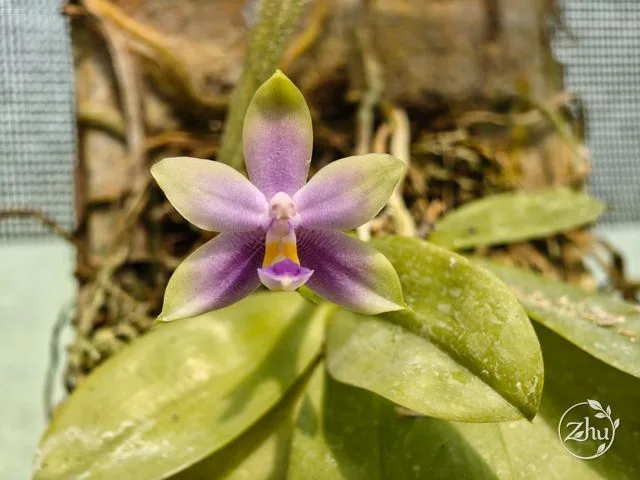
Compiled reference
Background
Phalaenopsis violacea is an orchid in the genus Phalaenopsis, family Orchidaceae. 紫紋蝴蝶蘭 ("purple-veined moth orchid") is the name commonly used in Taiwan's flower markets; the Taiwan Catalogue of Life and the iPlant database of the Chinese Academy of Sciences' Institute of Botany both call it 大葉蝴蝶蘭 ("large-leaved moth orchid").
It is an epiphyte, native from the Malay Peninsula to Sumatra, growing primarily in the wet tropical biome.
The "Malayan type" and the "Bornean type"
Plants from Borneo used to be included in this species, known informally among growers as the "Bornean type" as distinct from the "Malayan type". In 1995, Christenson and Whitten re-examined floral and vegetative morphology, together with analyses of floral fragrance and flavonoid pigment chemistry, concluded that the two deserved species status, and raised the "Bornean type" to a species of its own: Phalaenopsis bellina.
Flower colour
The white form (f. alba) and blue form (f. coerulea) that have been described are both treated by POWO as synonyms of P. violacea: they are not recognised as separate taxa, but included within this species.
Fragrance
A 2017 study from National Cheng Kung University in Taiwan reports that the scent of P. violacea and its close relative P. bellina at full bloom consists mainly of linalool, geraniol and their derivatives, and is emitted mainly during the day. In the study, the scent of P. violacea weakened under constant darkness and was strongest under white light.
The same study notes that these two species are commonly used to breed fragrant Phalaenopsis cultivars; about 730 hybrids with one of them as a parent are registered with the Royal Horticultural Society.
Conservation
The IUCN Red List assessed it as Vulnerable (VU) in 2010, with a decreasing population trend; threats include housing and agricultural development, collection and logging. IUCN also notes that the assessment needs updating, and the range it lists still includes Borneo.
The entire orchid family is listed in CITES Appendix II, and P. violacea is included. Appendix II means international trade is regulated, not banned; it governs cross-border trade and is separate from each country's own domestic law.
Sources
- Royal Botanic Gardens, Kew — Plants of the World Online (POWO): Phalaenopsis violacea H.Witte
- 臺灣物種名錄 TaiCOL: Phalaenopsis violacea 大葉蝴蝶蘭
- 中國科學院植物研究所 — iPlant 植物智: 大叶蝴蝶兰 Phalaenopsis violacea
- Christenson, E. A. & Whitten, M. W. — Brittonia 47: 57–60(1995): Phalaenopsis bellina (Rchb.f.) Christenson, a segregate from P. violacea Witte (Orchidaceae: Aeridinae)
- Chuang, Y.-C., Lee, M.-C., Chang, Y.-L., Chen, W.-H. & Chen, H.-H.(國立成功大學)— Botanical Studies 58: 50(2017): Diurnal regulation of the floral scent emission by light and circadian rhythm in the Phalaenopsis orchids
- IUCN Red List of Threatened Species: Phalaenopsis violacea
- UNEP-WCMC/CITES 秘書處 — Species+: Phalaenopsis violacea Witte — CITES Listings
My own observations
Cultivation
The first orchid genus I fell for
Phalaenopsis was the first orchid genus I fell for when I got into gardening. I remember going to the flower market every week back then, checking whether the few orchid nursery stalls had any species Phalaenopsis. Yes, I mean species Phalaenopsis: many of them differ quite noticeably in looks and habit from the moth orchids on the commercial market, but I just really enjoy looking at these species with their very different flowers, so I bought them and grew them as if obsessed.
Phalaenopsis violacea was one of the species I collected fairly early on. The plant in the photos is probably about 10 years old; I bought it back when I was still a student in Taichung.
Large leaves and fragrance
Its leaves are quite large compared with its flowers, and there are individuals with purple-red, blue-violet and greenish-white flowers.
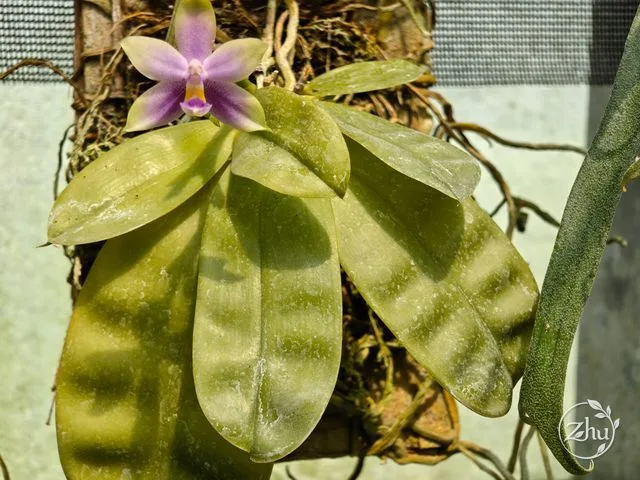
More importantly, when its flowers open they give off a lovely fragrance, which is one of the main reasons so many people love it. The scent is light and understated rather than showy, and it's more noticeable when there's enough sunlight, so whenever I'm watering or in the growing area during the day, I know from the smell that it's flowering again.
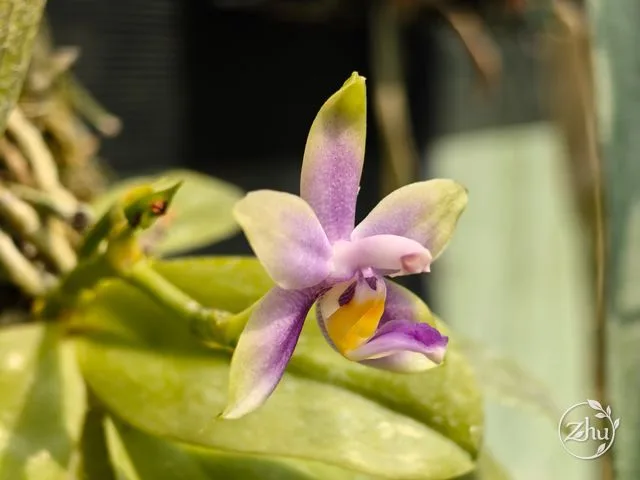
Growing it in northern Taiwan
The area where I grow my plants is in northern Taiwan. The occasional cold snaps in winter and the frequent rain make it hard to get the watering rhythm right, so many orchids don't grow especially well in my conditions. Even with a rain-sheltered net house, they're not easy to grow well, and for most of them I'm mainly just keeping them going to preserve the plants.
Phalaenopsis violacea, though, is one of the easier ones to keep. I mounted it on a board with a little sphagnum moss, and since then I've mostly let it grow as it likes, just watering on a regular schedule, with bright but indirect light. I can't say it grows especially well, but it still puts out a few flowers every year for me to enjoy.
Well worth recommending
If you like orchids and want something different from the commercial hybrids, keep an eye out for this one. It shouldn't be hard to find at any reasonably sized flower market, and it's well worth recommending.