 Zhu's Plant Journal
When buying plants you often come across the terms "seedling", "cutting" and "grafted plant". The difference is whether the plant grew from a seed or was propagated from part of another plant: the first is sexual propagation, the second asexual propagation. This article uses a few plants already on this site as examples to explain how the two differ.
Sexual propagation: genetic material recombined
Sexual propagation means propagating by seed. The genetic material of two parents is combined through pollination and fertilization, so the offspring differ from both parents.
This recombination happens in two steps:
-
Meiosis (inside each parent): as pollen and ovules develop, cells go through meiosis, which involves two divisions:
- The first division: the paired homologous chromosomes in the parent's cells (one originally from its own father, one from its own mother) pair up and exchange segments of DNA, called crossing over. Normally each pair of homologous chromosomes has at least one crossover, which is also needed for the chromosomes to separate correctly, but where and how often the exchanges happen varies each time. Each pair then separates into two cells; which chromosome goes to which side is random, and each pair is decided independently, which is called independent assortment. This is the step that halves the number of chromosomes.
- The second division: the two "sister chromatids" that each chromosome copied earlier separate. Because of crossing over in the first division, the sister chromatids are no longer quite the same, so the four cells that result all differ.
So even the reproductive cells from a single parent plant each carry a different combination of genes.
-
Fertilization (forming the zygote): a sperm cell from the pollen fuses with the egg cell in the ovule to form a zygote, which develops into the embryo in the seed. Half of the offspring's genetic material comes from the pollen parent and half from the seed parent.
So even seeds from the same fruit usually don't receive exactly the same combination of genes. That is why a single batch of seedlings so often grows up looking varied.
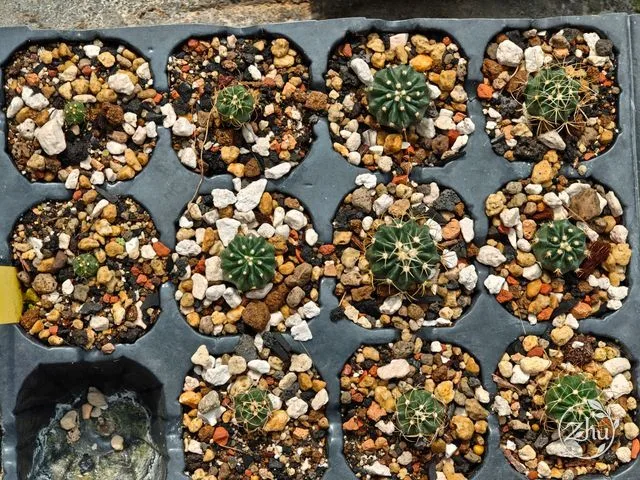
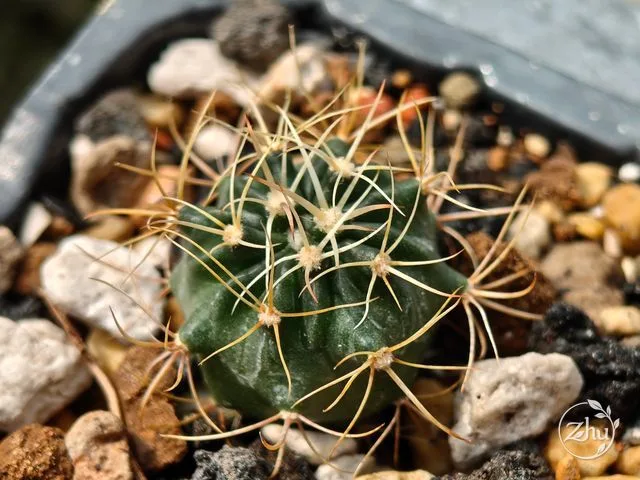
The horse crippler seedlings on this site are an example: among a dozen or so offspring, you can already see that the spine length varies a lot.
Asexual propagation: a new plant from part of a plant
Asexual propagation uses vegetative parts such as stems, roots and leaves and lets them grow into one or more new plants. With few exceptions, the new plants are genetically identical to the parent; a group of plants obtained this way is called a clone.
Common methods include:
- Cuttings: a piece of the plant is cut off and allowed to root. Depending on the part used, there are stem, leaf and root cuttings.
- Layering: a stem is made to root while still attached to the parent, and is cut off once it has rooted. Air layering is one form: the stem is wounded or girdled, wrapped in moist sphagnum moss and then covered in plastic. Layering has a high success rate because the stem can still draw water and nutrients from the parent.
- Division: a clump is split into several plants. Runners that a plant produces on its own (such as strawberry and spider plant) and offsets at its base (such as haworthia and bromeliads) can be cut off and planted separately, which is also a form of division.
- Separation: new small bulbs or corms form beside the old one and are separated and planted.
- Grafting and budding: a piece of stem or a bud (the scion) is joined to the roots or trunk of another plant (the rootstock) so that the two heal into one plant.
- Tissue culture: plants are multiplied in large numbers from tiny pieces of tissue or organs on a sterile medium.
The crape myrtle grafted onto Lagerstroemia subcostata on this site is a graft: a trunk of 九芎 (Lagerstroemia subcostata) serves as the rootstock, with a specially selected crape myrtle grafted on top.
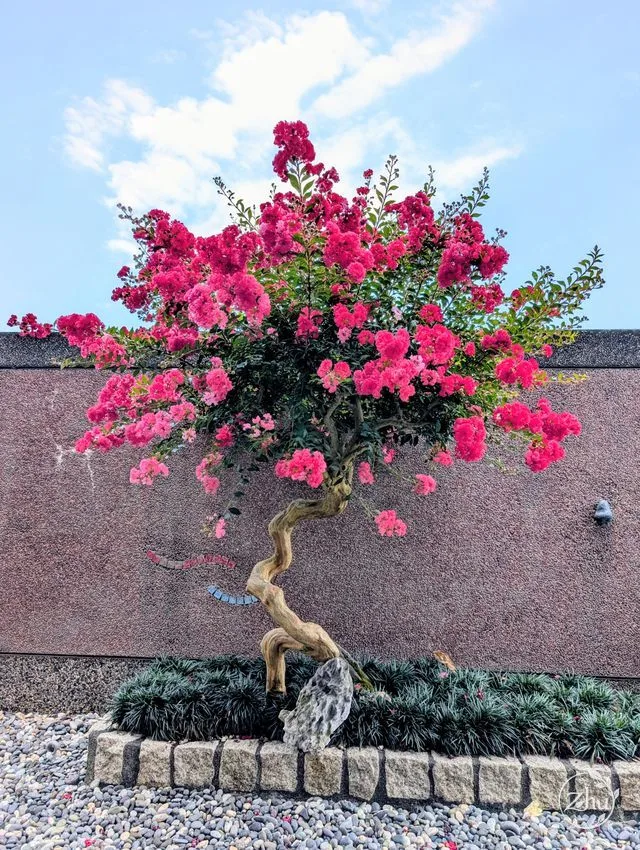
In a graft, the scion carries the traits of the crape myrtle cultivar, while the roots and lower trunk are L. subcostata. Scion and rootstock each keep their own genes, so a grafted plant is really two plants combined.
Asexual propagation has exceptions too
"Genetically the same as the parent" doesn't guarantee an identical-looking plant. There are two common exceptions:
- Variegation isn't always kept: when a variegated snake plant is propagated from leaf sections, the new shoot develops from cells without the variegation, so the new plant may lose it; for a variegated jade plant, stem cuttings are recommended to preserve the genetic material behind the change in leaf colour.
- Tissue culture occasionally produces variation: tissue-cultured plants from a single source sometimes show variations that differ from the parent, called somaclonal variation. This is linked to culture conditions, and it is especially likely when plants are regenerated by first growing a callus (a mass of undifferentiated cells). So keeping the parent's traits in tissue culture requires checking that the plants are genetically consistent.
Seeds that are copies: apomixis
Conversely, some plants produce seeds asexually, which is called apomixis. In these plants embryos form without meiosis and fertilization; it occurs in at least 400 plant species but is rarely reported in crops.
Citrus is a familiar example. Besides the embryo formed by fertilization, a citrus seed can also contain embryos that develop from the nucellus, maternal tissue within the ovule. Seedlings from these embryos are genetically identical to the mother plant, and one seed can hold several embryos. This lets citrus growers raise uniform rootstocks from seed, but it also makes cross-breeding more difficult.
So "grown from seed" doesn't always mean "different from the parent"; it depends on how the embryo was formed.
How gardeners choose
Broadly, there are two situations: breeding, and growing plants in quantity.
Breeding: variation is the point
Breeding is after new combinations of genes, so it relies on sexual propagation: parents are crossed, the seed is sown, and the best-performing individuals are selected from the seedlings. Because sexual propagation keeps genetic variation, it is what makes new cultivars possible.
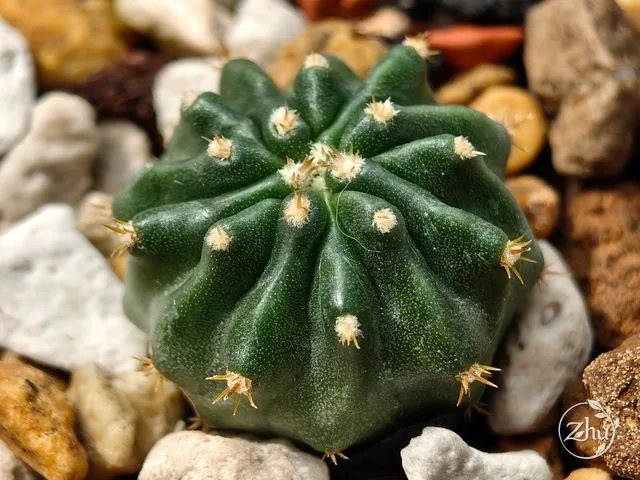
Hobbyists who sow seed and pick out unusual individuals are doing the same thing. The kikko star cactus seedlings on this site are few in number, yet already show individual differences, and one even came up with yellow variegation.
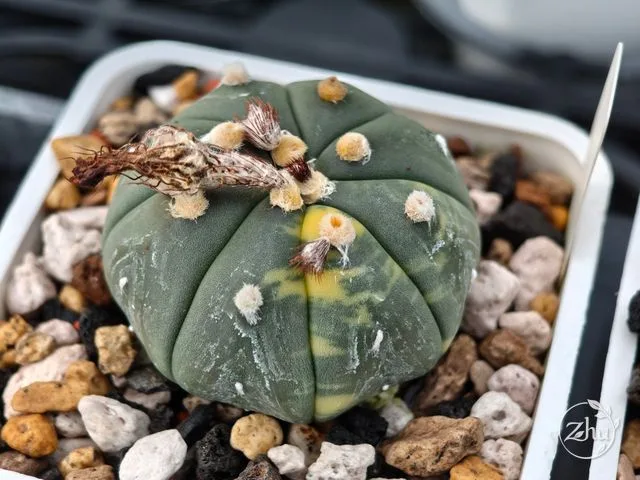
Once a good individual has been selected, keeping its traits means switching to asexual propagation.
Growing in quantity: uniformity is the point
When plants are grown in quantity, the aim is for every plant to be the same, with predictable quality.
- Cultivars such as fruit trees are mostly propagated asexually: fruit trees are rarely propagated from seed unless no superior cultivar is known or rootstocks are being grown, because their desirable traits can only be kept through asexual propagation. Some cultivars can also only be perpetuated asexually, and special growth forms such as weeping or dwarf types depend on it too.
- Seed can also give uniform plants: F1 cultivars, common among vegetables and annual flowers, are seedlings, yet the plants from one packet come out very uniform; the reason is explained below.
In practice, a few other factors also come into play:
- Cost and speed: propagation by seed may be quicker and more economical than asexual propagation, but asexual propagation can produce a large plant more quickly than seed. Tropical fruit trees grown from seed usually take many years to become mature enough to bear fruit, with a few exceptions such as papaya.
- Whether seed is available, and how easily it roots: some plants can only be propagated by seed; for cultivars that root poorly, or when little scion material is available, grafting or budding is the better choice.
- Disease: propagating by seed can avoid passing on diseases such as viruses.
F1: why these seedlings come out uniform
On vegetable and flower seed packets you often see "F1" after the cultivar name. F1 means "first filial generation": the first generation from crossing two parents. Although these plants are also seedlings, the plants from one packet come out very uniform.
It comes down to the parents
Breeders use parents that have already been backcrossed or selfed many times, so that their genotypes have reached a certain degree of stability and purity, and then cross two such parents. The resulting offspring are especially uniform, consistent in flowering time, height, yield and maturity.
Why are they uniform? Parents backcrossed or selfed many times are genetically almost pure lines: for most genes, the alleles are nearly identical. Crossing over still happens in meiosis, but because the two homologous chromosomes are almost identical, the exchanges create no new combinations. Because the parents are almost pure lines, each reproductive cell carries almost the same genes, and every F1 seed from crossing the two parents receives the same combination. So for many genes, an F1 plant carries a pair of alleles from two different parents that are not the same, which is called "heterozygous"; yet the F1 plants are uniform with one another.
The inbred parents themselves are weak, while the F1 offspring are vigorous; this is called hybrid vigour.
Seed saved from F1 plants won't be uniform
Because an F1 plant is heterozygous, every reproductive cell it produces is genetically different. So when seed from F1 plants is sown again, the traits of the second generation (F2) segregate and are no longer as uniform, nor true to the parent type.
This is one reason F1 seed costs more: every batch has to be made by crossing the two parent lines again.
The "F1" of succulent and orchid growers is different
Succulent and orchid growers also often say "F1", but usually mean the first generation from crossing two individual plants, not such purified lines.
The clonal cultivars used in crosses are highly heterozygous, and the offspring of such a cross segregate; breeders select new superior individuals from among them. In other words, although this kind of F1 is also a "first generation", the individuals can still differ a great deal, just as the horse crippler seedlings above, grown from a single batch of seed, turned out quite varied.
So when you see "F1", it's worth asking which kind it means:
| F1 cultivar on a seed packet | First generation from crossing two plants | |
|---|---|---|
| Parents | Backcrossed or selfed many times, genetically almost pure lines | Ordinary individuals, genetically heterozygous |
| Among the F1 | Very uniform | May differ a great deal |
| Seed saved and resown (F2) | Traits segregate; not uniform | Also segregate |
Seedling records on this site
Citations and sources
Sources
- North Carolina State University Extension: Extension Gardener Handbook, Chapter 13: Propagation (LeBude, A. V. & Blazich, F. A., AG-831, 2022)
- National Human Genome Research Institute (NHGRI): Talking Glossary of Genomic and Genetic Terms: Meiosis
- OpenStax, Rice University: Clark, M. A., Douglas, M. & Choi, J. Biology 2e (2018), 11.1 The Process of Meiosis
- National Human Genome Research Institute (NHGRI): Talking Glossary of Genomic and Genetic Terms: Crossing Over
- Frontiers in Plant Science: Gutiérrez Pinzón, Y., González Kise, J. K., Rueda, P. & Ronceret, A. (2021). The Formation of Bivalents and the Control of Plant Meiotic Recombination. 12: 717423
- Virginia Cooperative Extension, Virginia Tech: Propagation by Cuttings, Layering and Division (Relf, D. & Ball, E., 426-002, reviewed 2025)
- International Journal of Molecular Sciences: Duta-Cornescu, G. et al. (2023). Somaclonal Variation—Advantage or Disadvantage in Micropropagation of the Medicinal Plants. 24(1): 838
- DNA Research: Jia, H.-H. et al. (2021). Transcriptomes and DNA methylomes in apomictic cells delineate nucellar embryogenesis initiation in citrus. 28(5): dsab014
- University of Florida IFAS Extension (EDIS): Tropical and Subtropical Fruit Propagation (Wasielewski, J. & Balerdi, C., HS1349)
- Royal Horticultural Society (RHS): F1 hybrids
- Iowa State University Digital Press: Fehr, W. R. & Suza, W. P. Plant Breeding Methods, chapter “Population Formation by Hybridization” (2024)