 Zhu's Plant Journal
Compiled reference
Background
This is an epiphytic orchid whose currently accepted name in POWO is Dinema polybulbon, in the genus Dinema. The name often seen in horticulture, Epidendrum polybulbon, is the name it was first published under and is now treated as a synonym. 聚豆樹蘭 is the name used in Taiwan's market; the iPlant database of the Chinese Academy of Sciences' Institute of Botany calls it 雙絲蘭.
How the name has changed
Swartz published the species in 1788 as Epidendrum polybulbon; in 1831 Lindley moved it to Dinema, as Dinema polybulbon, the name POWO accepts today. In 1961 Dressler placed it in Encyclia (Encyclia polybulbon), a name that is likewise now treated as a synonym. According to POWO, Dinema currently contains only this one species.
Distribution
It is native to Mexico (central, Gulf coast, south-east and south-west), Belize, Guatemala, Honduras, El Salvador, Nicaragua, Panama, Cuba, Jamaica and the Windward Islands. It is a pseudobulbous epiphyte growing primarily in the wet tropical biome.
CITES
The entire orchid family is listed in CITES Appendix II, and this species is included. Appendix II means international trade is regulated, not banned; it governs cross-border trade and is separate from each country's own domestic law.
Sources
- Royal Botanic Gardens, Kew — Plants of the World Online (POWO): Dinema polybulbon (Sw.) Lindl.
- Royal Botanic Gardens, Kew — Plants of the World Online (POWO): Dinema Lindl.
- 中國科學院植物研究所 — iPlant 植物智: 双丝兰 Dinema polybulbon
- UNEP-WCMC/CITES 秘書處 — Species+: Dinema polybulbon (Sw.) Lindl. — CITES Listings
My own observations
Cultivation
Tiny pseudobulbs
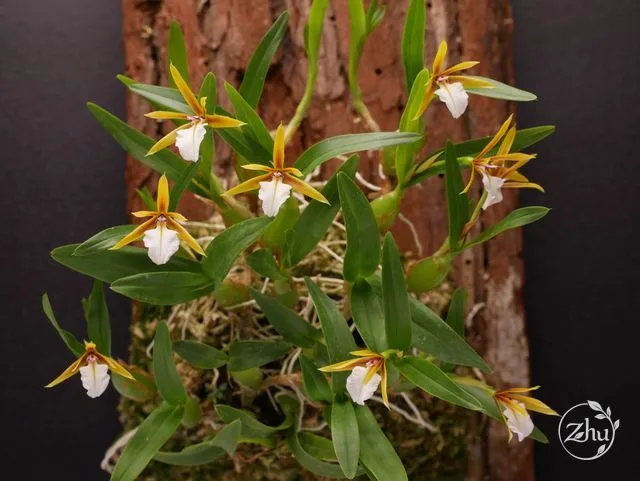
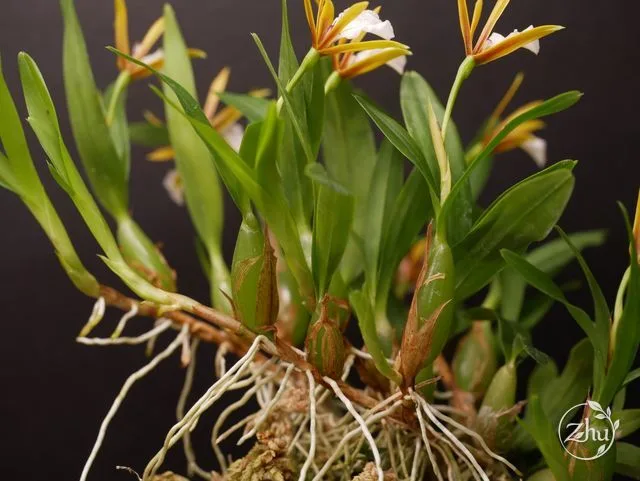
This is a small, charming orchid; I recorded it when it was in full bloom in the garden, around spring. A single pseudobulb growth is about 5 cm tall, and the pseudobulbs are really cute: a plump pseudobulb at the base, with two leaves growing from the top. In the flowering season, the flowers emerge from between the two leaves.
Elegant flowers
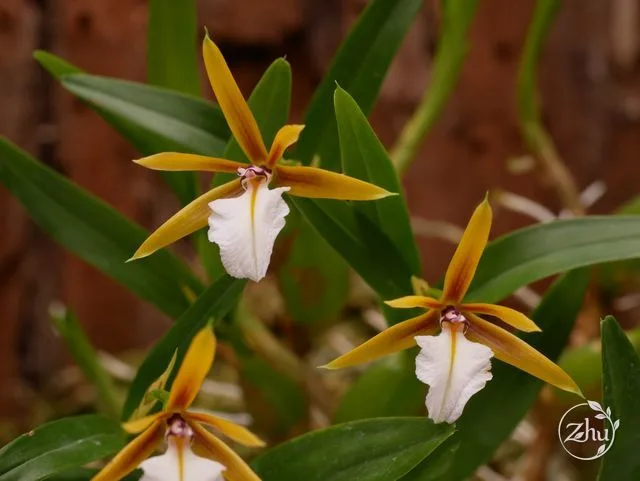
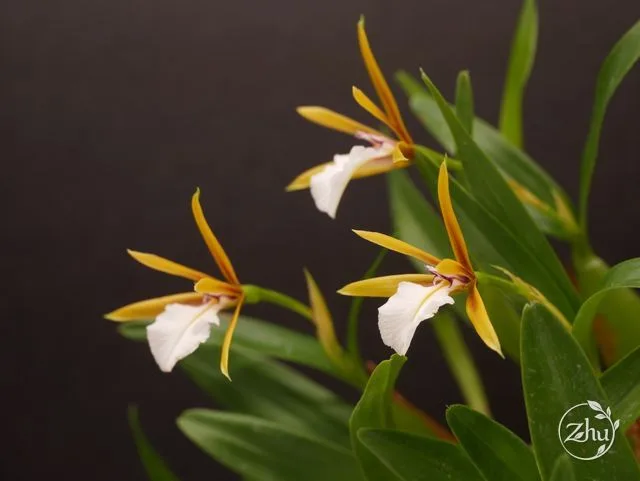
Each flower is only about 2 cm across, but I find them very elegant. The sepals and petals are orange-brown, with purple-red stripes along the midrib near the centre, and there's a large white lip with a yellow line down the middle.
Gradually forming a clump
Although a single growth looks quite small, it is a sympodial orchid, so new pseudobulbs keep growing one after another. The pseudobulbs, with their white aerial roots, cling to the surface of the mount and gradually form a clump, so when they flower together the effect is lively and colourful.
How I grow it
It likes bright, diffuse light, so I usually keep it on a lower level. It can be divided when planting: I split it into units of about three or four growths and mount them on bark. When I first mount them, I like to put down a thin layer of sphagnum moss to help hold the plant in place and give it more moisture at the start. Once the plant starts growing new roots and they cling to the mount, and it has settled in, after that it's just very basic everyday watering.
Whenever I water my other plants, I give these a spray too. The key is to moisten the mount they're growing on, so that the water evaporating from it creates a microclimate that provides some humidity. All in all, it's an easy plant to satisfy; I don't think it's hard to grow, and I'd say it's one of the more approachable orchids.