 Zhu's Plant Journal
 In this post I want to share something: the mature fertile fronds of a staghorn fern grow sporangia on their backs, and the form of those sporangia actually differs somewhat depending on the species or variety.
Is that yellow-brown stuff on the back of the frond mould?
People who grow staghorn ferns sometimes notice, once the plant has been growing for a while, yellow-brown patches on the backs of the fronds, and they ask: is this mould? Is the plant sick?
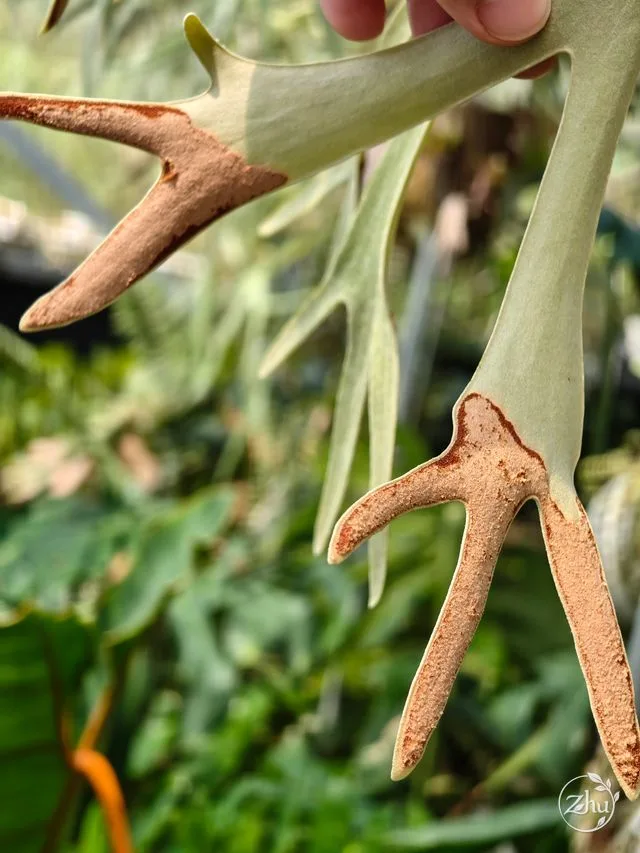
It's actually what mature staghorn sporangia look like. Sporangia develop on the backs of mature fertile fronds. At first they're pale green, then gradually turn red-brown; when they're truly ripe, you'll find a thin layer on the surface peels away, and what's inside feels rough, like tiny grains of fine sand.
For the difference between fertile fronds and shield fronds, see the earlier post, The two kinds of staghorn fern fronds.
Different staghorn ferns, different sporangia
Depending on the species or variety, staghorn ferns form their sporangia in rather different ways.
Red oval or palm-shaped patches at the frond tips
The most common kinds, such as Platycerium bifurcatum and its hybrids with P. willinckii, P. hillii and 銀鹿 (P. veitchii), form reddish oval or palm-shaped sporangial patches at the tips of the fronds. The horticultural selection 藍猴 ("Blue Monkey") in the photo is a selected individual from the so-called bifurcatum × hillii × willinckii hybrid group.
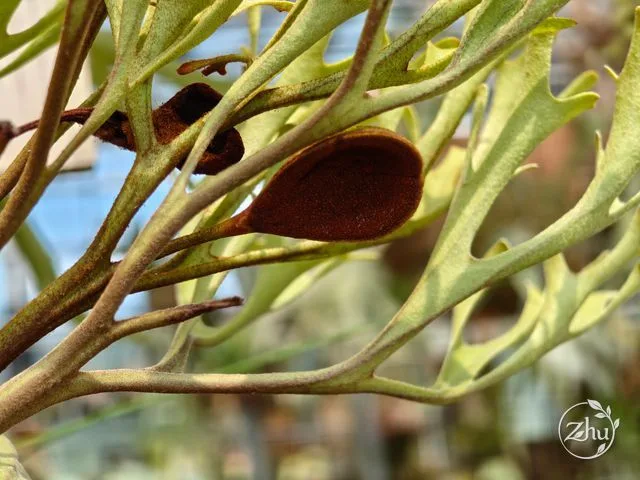
A spoon-shaped or flat, disc-like structure
Others, such as Ridley's staghorn fern (P. ridleyi) and some of the giant staghorns like P. wandae (女王), P. grande (巨獸) and P. wallichii (蝴蝶), form a spoon-shaped or flat, disc-like structure at one spot on the fertile frond and produce their sporangia there.
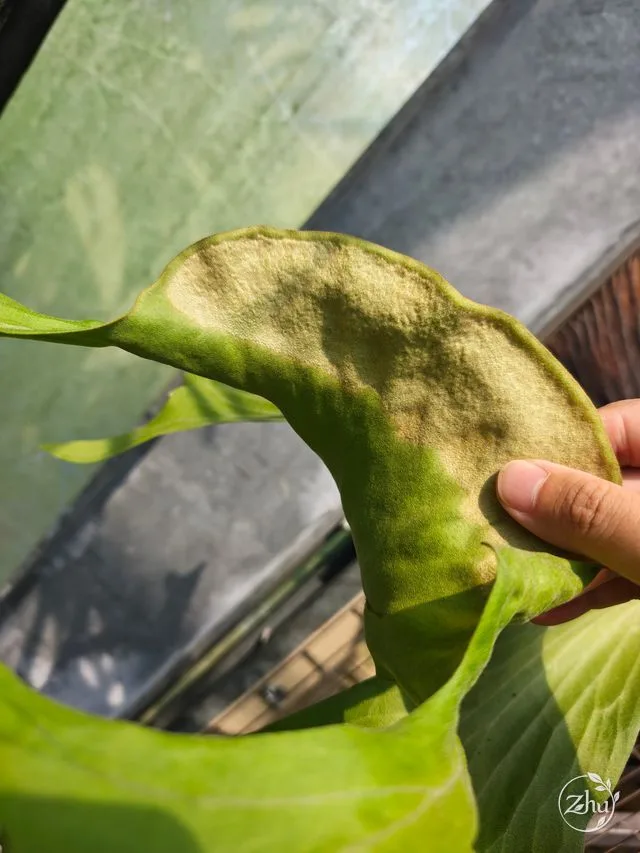
One large patch
There are also ones like P. elephantotis, which has one large patch of sporangia.
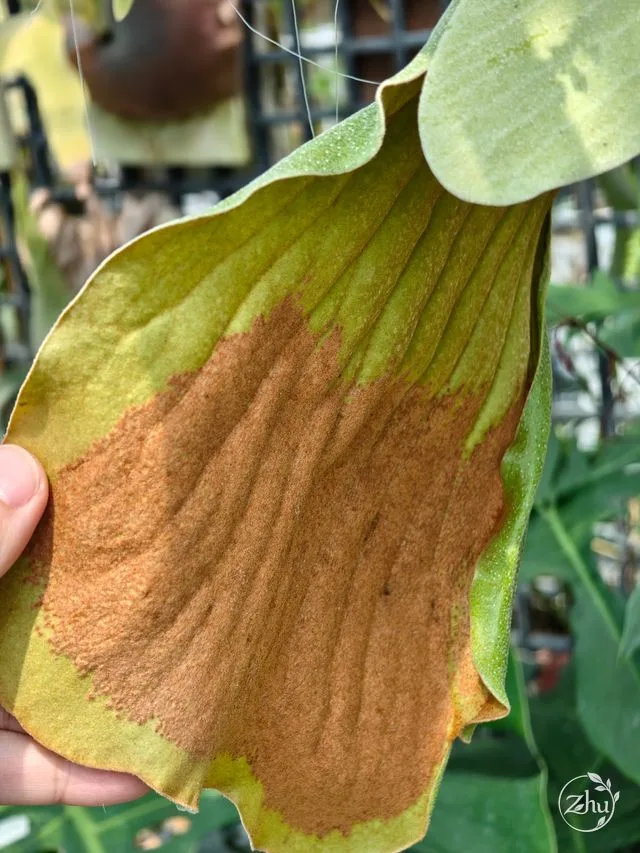
Sporangia that make the frond curl
And some have more unusual sporangia that make the frond curl as they mature. The best known is the one commonly called 捲捲鹿 ("curly staghorn", P. 'Foong Siqi'): when its fertile fronds mature and form sporangia, the fronds curl, giving the whole plant a very cute, appealing look. That's one of the reasons many people love this staghorn.
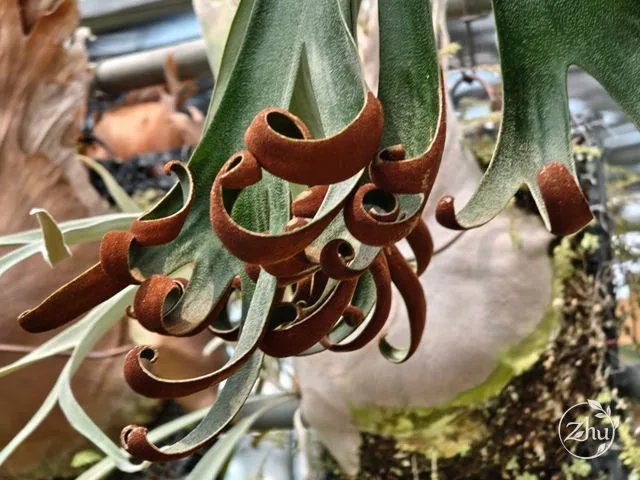
So I hope these photos I've taken give everyone a bit more familiarity, and show that staghorn fern sporangia come in quite a variety of forms.
Names and scientific names
- The English edition of the Flora of China describes the sori of Platycerium as forming large sporangial patches.
- Scientific names used here: Platycerium bifurcatum (二叉鹿角蕨) follows the Taiwan Catalogue of Life; the Chinese names for P. willinckii (爪哇), P. hillii (深綠), P. wandae (女王) and P. elephantotis (象耳) follow the iPlant database of the Chinese Academy of Sciences' Institute of Botany, and all of these names are accepted in the Catalogue of Life.
- 捲捲鹿 is listed in iPlant as the cultivar Platycerium 'Foong Siqi'.
- 銀鹿 P. veitchii, 巨獸 P. grande and 蝴蝶 P. wallichii: the Chinese names are the trade names used in Taiwan.
Citations and sources
Sources
- 臺灣物種名錄 TaiCOL: Platycerium bifurcatum 二叉鹿角蕨
- 中國科學院植物研究所 — iPlant 植物智: 鹿角蕨属 Platycerium(下級列表)
- Catalogue of Life(ChecklistBank 3LR): Platycerium — 名稱查詢
- Flora of China Editorial Committee — Flora of China, Vol. 2–3(eFloras): Platycerium Desvaux 鹿角蕨属