 Zhu's Plant Journal
 Staghorn ferns (genus Platycerium) grow two kinds of frond on the same plant, different in both form and function. The Flora of China describes their fronds as "extremely dimorphic". Knowing the two apart makes it less likely you'll mistake a normal change for a problem.
Two kinds of frond, several names each
| Shield frond | Fertile frond | |
|---|---|---|
| Other names | basal frond, nest frond, sterile frond | foliage frond |
| Chinese | 營養葉、盾狀葉、巢葉 | 孢子葉、可孕葉 |
| Where it grows | Pressed against the surface the plant grows on, covering the roots | Growing out from the centre of the plant, usually in pairs |
| Bears spores? | No | Yes |
| Main job | Anchoring the plant and collecting water and fallen leaves | Producing spores |
The University of Florida extension puts it simply: shield fronds are flat, cover the roots and help the plant attach to its support; they are sterile and collect water and fallen plant debris. Fertile fronds are the more eye-catching ones, and brownish sporangia form on their undersides.
What the two share is a fleshy, leathery texture, and when young, a covering of star-shaped (stellate) hairs.
Shield fronds: pressed flat, wrapping, catching leaves
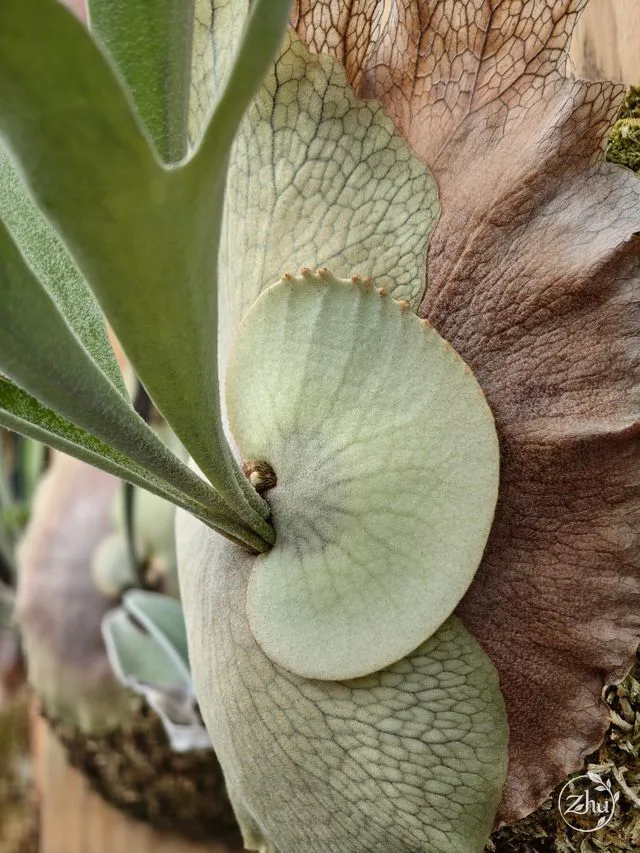
Shield fronds persist on the plant, their bases pressed tightly against the surface. Their upper edge may be entire or forked several times, so the outline of the shield fronds varies a lot between staghorn ferns: some are round, others have many points along the top.
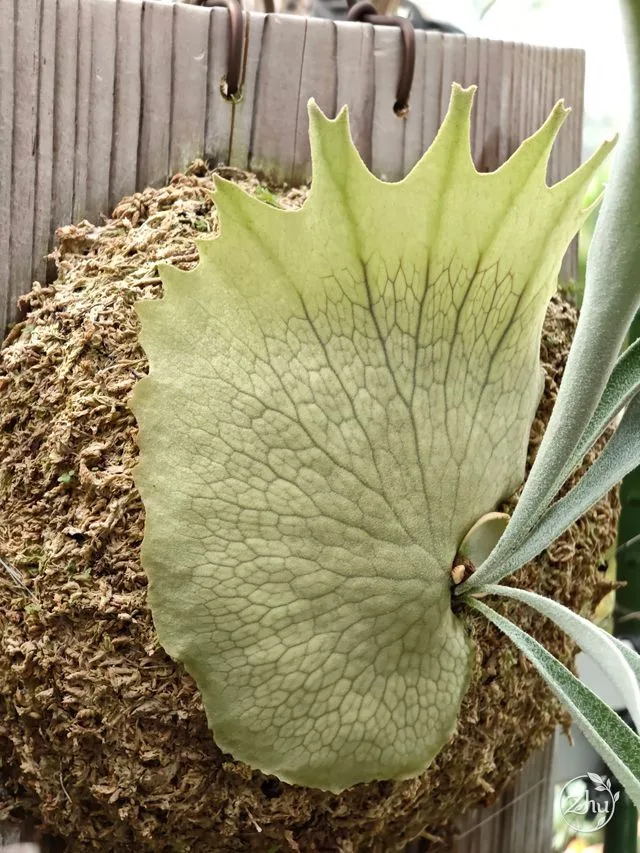
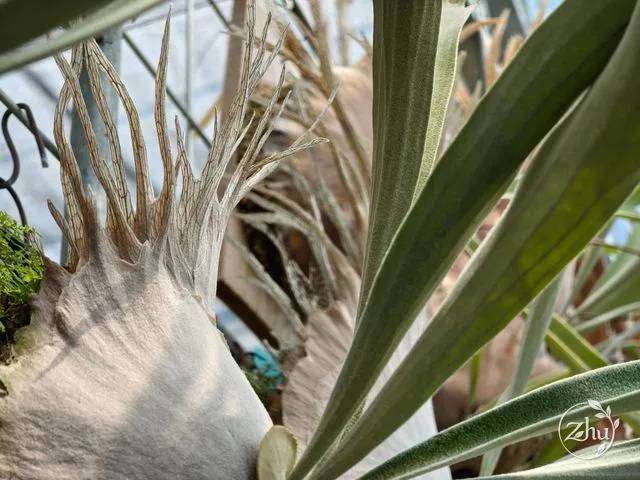
Singapore's National Parks Board description of the crown staghorn fern (Platycerium coronarium) shows well how shield fronds work in the wild. The fronds together form a crown-like basket that catches leaves falling from the host tree. New shield fronds keep growing on the outside, replacing the old ones, which die, curl up and grip the leaf litter inside. The fern's roots grow into this mass of decaying leaves for water and nutrients.
In the crown staghorn fern, then, old shield fronds dying and turning brown is simply part of how the plant works.
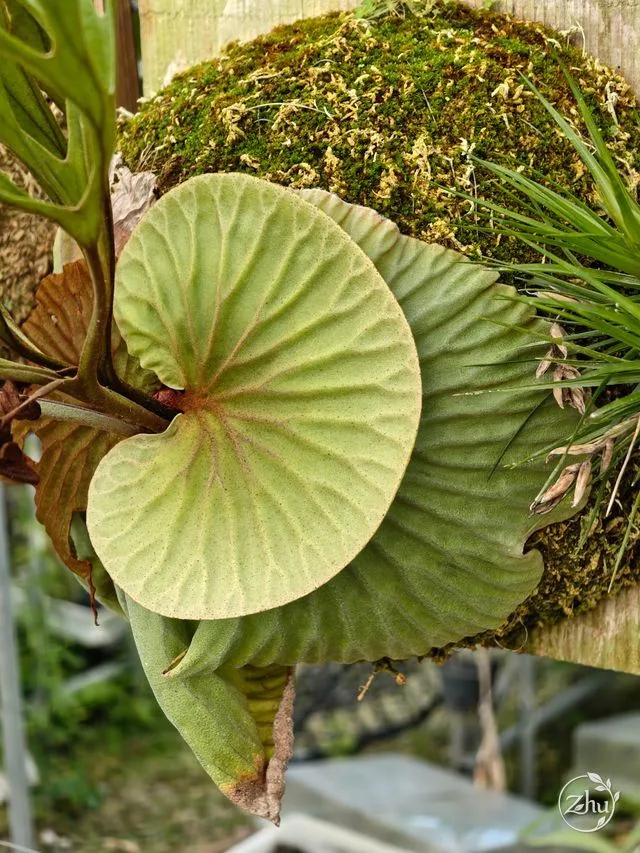
Shield fronds differ a great deal between species. In Platycerium ridleyi they are round and corrugated, overlapping one another, and in the wild ants often nest inside them. In the Philippine Platycerium grande they can be more than a metre across, curling back as they age.
Fertile fronds: antler-like, with spores on the back
Fertile fronds usually grow in pairs. They can be a single undivided blade or fork repeatedly, and their posture ranges from erect to hanging. The genus name Platycerium comes from the Greek for "broad" and "horn", referring to its antler-like fronds.
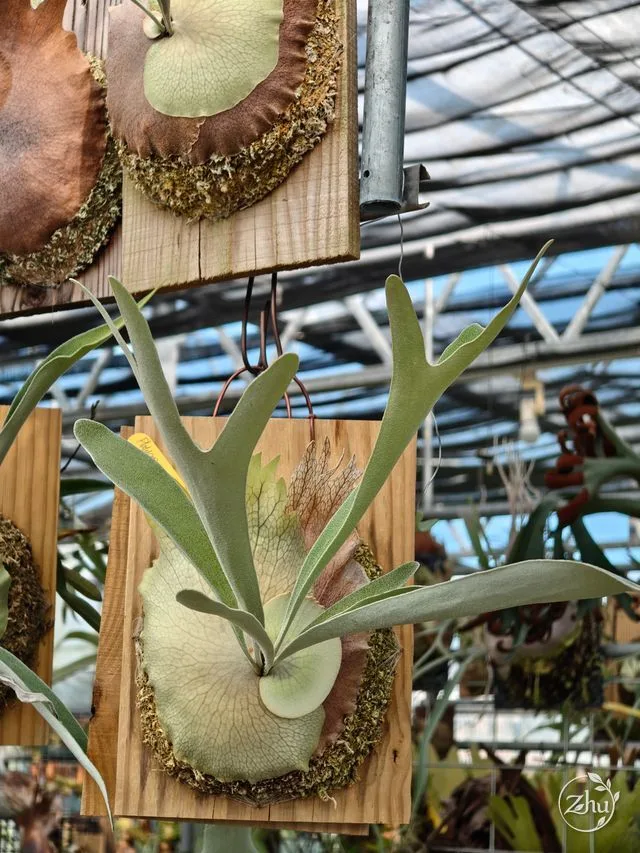
The spores form on the undersides of the fertile fronds, gathered into large brown patches. The University of Florida extension specifically notes that these brown patches are normal reproductive structures, not disease.
Where and how the sporangia are borne varies a lot between species:
- Platycerium grande: a single semicircular spore patch on the underside of the fertile frond, up to 45 cm long.
- Crown staghorn fern: long, narrow fertile fronds hanging up to 2 m, forking repeatedly into a net; the spores are borne on semicircular, ear-like lobes on the underside.
- Platycerium ridleyi: the sporangia are on separate lobes, and each sporangium holds only 8 spores; other staghorn ferns have 64.
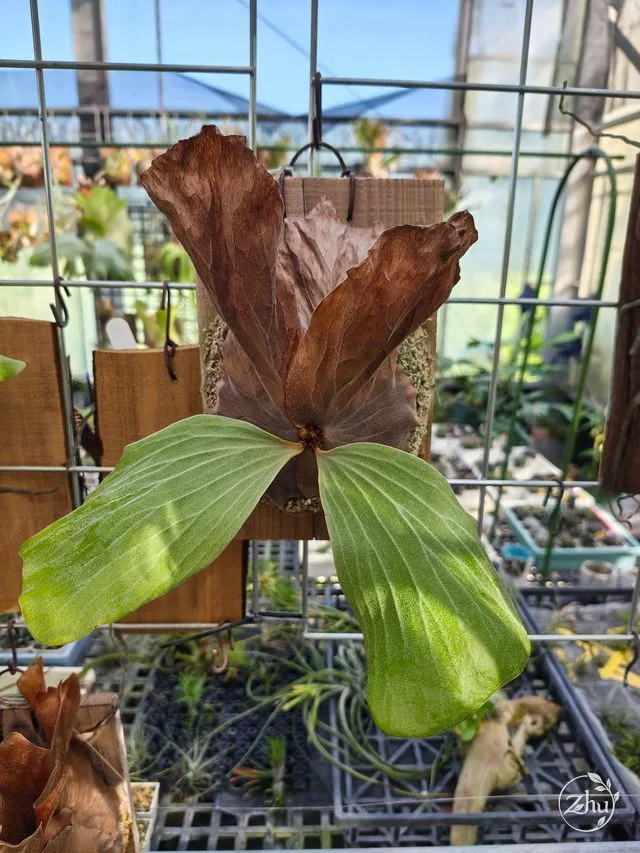
It isn't true that fertile fronds "always fork like antlers". The Flora of China describes them as anything from undivided to forked several times, and Platycerium elephantotis is clearly an undivided example.
Growing singly or in clumps
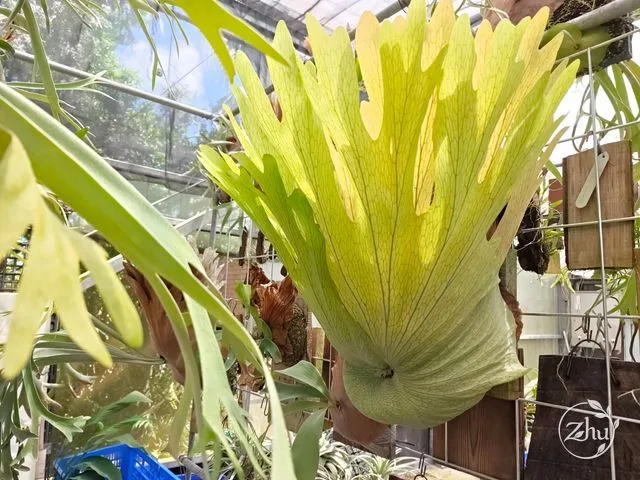
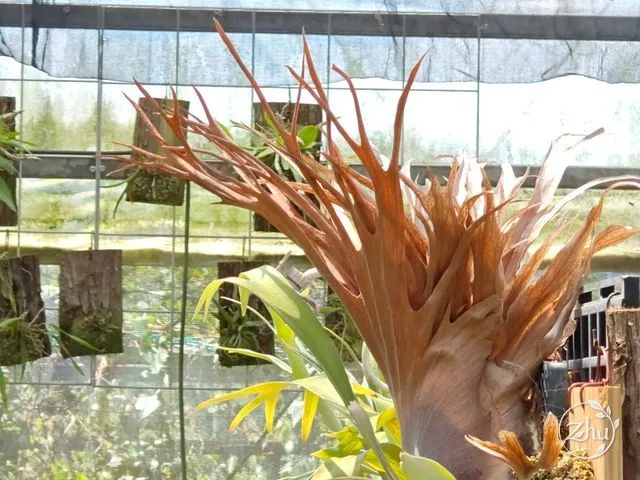
Some staghorn ferns grow as single plants, others form clumps. The two photos below are my own observation, comparing the shield fronds of the two growth forms. In my growing conditions, the shield fronds of single-crown plants usually last longer before ageing, and I rarely see a stage where the outermost shield fronds stay visibly yellow and withered.
Where they grow
There are about 18 species of Platycerium. Just 1 grows in South America, from Peru to Bolivia; the rest span the tropics and subtropics of the Old World, reaching Australia.
In one line
Shield fronds hold on and catch water and organic debris from their surroundings, and turn brown with age; fertile fronds reproduce, and the brown on their backs is spores. How both look varies widely between species, which is exactly what makes collecting different staghorn cultivars and species so much fun.
Citations and sources
Sources
- University of Florida IFAS Extension — Gardening Solutions: Staghorn Fern Mounting Tutorial
- Flora of China Editorial Committee — Flora of China, Vol. 2–3(eFloras): Platycerium Desvaux 鹿角蕨属
- 新加坡國家公園局 NParks — Flora & Fauna Web: Platycerium coronarium (J.Koenig ex O.F.Müll.) Desv.
- 新加坡國家公園局 NParks — Flora & Fauna Web: Platycerium grande (A.Cunn. ex Hook.) J.Sm.
- 新加坡國家公園局 NParks — Flora & Fauna Web: Platycerium ridleyi Christ(Ridley's Staghorn Fern)
- Royal Botanic Gardens, Kew — Plants of the World Online (POWO): Platycerium Desv.
- Catalogue of Life(ChecklistBank,COL 最新版): Platycerium Desv.