 Zhu's Plant Journal
Compiled reference
Background
This fern belongs to the genus Platycerium in the family Polypodiaceae. Its scientific name is Platycerium ridleyi.
It is native to rainforest in Thailand, Sumatra, Peninsular Malaysia and Borneo, at about 0 to 700 metres. Singapore once had wild populations too, but they are now extinct. The species name honours Henry Nicholas Ridley, the first director of the Singapore Botanic Gardens, who discovered the plant in the Bukit Timah forest in Singapore.
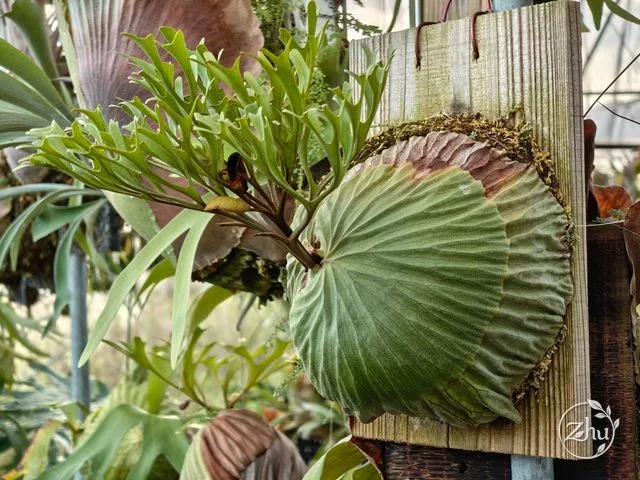
It has two kinds of fronds. The sterile nest fronds (the shield fronds) are corrugated, about 20 to 50 cm long and wide, and overlap one another to form an enclosed space with its base against the surface the plant grows on; in the wild, ants often nest inside them. The fertile fronds are 25 to 50 cm long or more, repeatedly forked, stiff and leathery, and grow upward like antlers. The sporangia are not borne on the backs of the fertile fronds but on separate lobes, which are obovate to elliptic and about 5 to 17 cm long.
The IUCN Red List assessed it as Near Threatened in 2026, with a decreasing population. The threats listed include housing development, agriculture, plant gathering and logging, and international horticultural trade is also recorded.
It is not listed in the CITES Appendices.
Sources
- Catalogue of Life(ChecklistBank,COL 最新版): Platycerium ridleyi Christ
- 臺灣物種名錄 TaiCOL: Platycerium 鹿角蕨屬
- 新加坡國家公園局 NParks — Flora & Fauna Web: Platycerium ridleyi Christ(Ridley's Staghorn Fern)
- IUCN — The IUCN Red List of Threatened Species: Cicuzza, D. & Rivers, M.C. 2026. Platycerium ridleyi. e.T272334461A272350189
- UNEP-WCMC/CITES 秘書處 — Species+: Platycerium — 查詢
My own observations
Cultivation
An unusual look
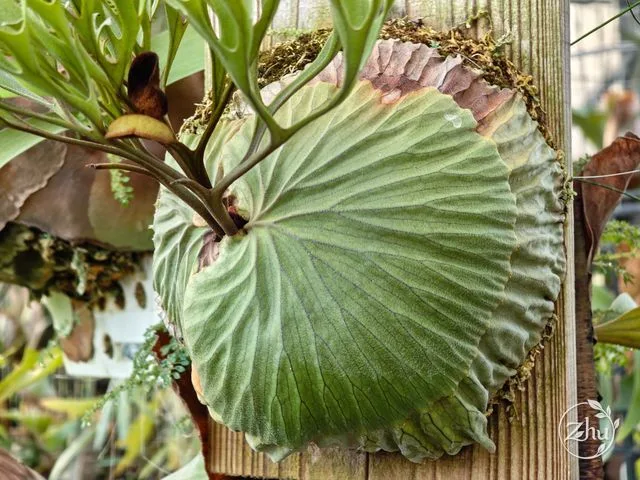
This has long been a favourite among staghorn fern lovers. Compared with other staghorn ferns its form is quite different: the shield fronds are round, pressed flat against the potting media, with a bumpy, ridged texture.
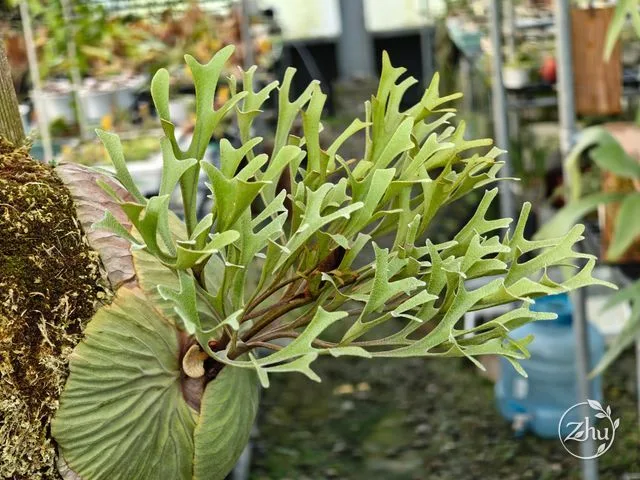
Unlike other species whose fertile fronds can be quite long overall, its fertile fronds are usually held out and angled upward, and different plants range from narrow-leaved to broad-leaved. Grown well, its overall proportions are very ornamental.
The spore-bearing lobes
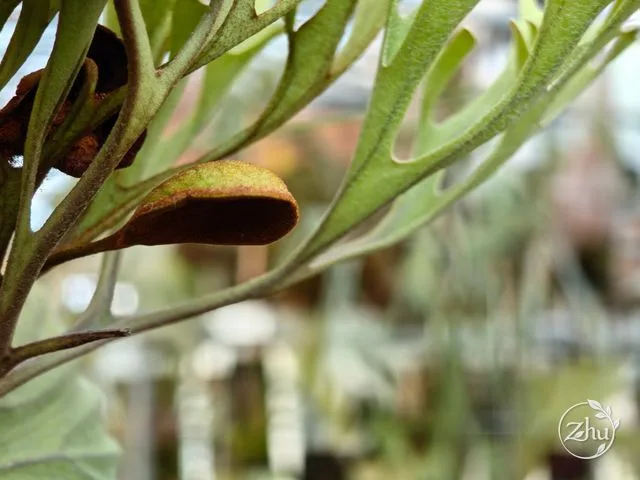
Its spore-bearing structures are also a little different from those of other species. Other staghorn ferns bear their sporangia on the backs of mature fertile fronds, but this one bears them on separate spore-bearing lobes that grow out on their own, shaped something like a spoon.
Why it isn't easy to start with
In my experience it is a bit harder to look after than other staghorn ferns. The main reason is probably that its roots are quite sensitive to how wet or dry the media is. If it accidentally gets too dry or too wet, or even if the density of the media isn't right or the area around the growing tip isn't properly covered with media, growth tends to be only so-so.
Also, because the fronds press against the media, as more and more fronds cover it you need to water carefully, or most of the water will run off the fronds onto the ground without actually soaking into the media.
It is also relatively prone to attack by pests and molluscs. In my growing area, when the staghorn ferns kept together get attacked, it is very often this one that suffers first. For all these reasons it is a little hard to get started with at home.
The conditions it likes
In fact, the conditions it likes are not very different from other staghorn ferns: bright diffused light, a steady cycle between slightly dry and slightly moist, and good airflow will let you grow it beautifully. It doesn't need heavy feeding; frequent weak doses or a slow-release fertiliser both work. Once the plant is growing steadily, looking after it is not that hard.