 Zhu's Plant Journal
Mammillaria humboldtii 'Caespitosa'
Mammillaria humboldtii C.Ehrenb.
Mammillaria Succulents and cacti
Compiled reference
Background
姬春星 is a cactus in the genus Mammillaria, which iPlant calls 乳突球屬 and the Taiwan Catalogue of Life calls 銀毛球屬. This page stays at the species level, Mammillaria humboldtii: plants sold as 姬春星 are often labelled M. humboldtii var. caespitosa or f. caespitosa, but that name can't be found in POWO, the International Plant Names Index (IPNI) or the Catalogue of Life. The iPlant database of the Chinese Academy of Sciences' Institute of Botany lists it as a cultivar under the species, 'Caespitosa'. The Chinese names aren't consistent either: iPlant calls the whole species M. humboldtii 姬春星.
It is native to the Mexican states of Querétaro and Hidalgo, a succulent subshrub growing primarily in the desert or dry shrubland biome.
Conservation
The IUCN Red List assessed M. humboldtii in 2009 (published 2013) as Critically Endangered (CR): in the wild it is known from a single location in Hidalgo, Mexico, at 1,350 to 1,500 m, in shrubland and rocky areas. Its population is decreasing, threats include livestock grazing and collecting, and it is traded for horticulture both nationally and internationally. IUCN also notes that the assessment needs updating.
The entire cactus family is listed in CITES Appendix II (except species in Appendix I), and this plant is included. Appendix II means international trade is regulated, not banned; it governs cross-border trade and is separate from each country's own domestic law.
Sources
- Royal Botanic Gardens, Kew — Plants of the World Online (POWO): Mammillaria humboldtii C.Ehrenb.
- 中國科學院植物研究所 — iPlant 植物智: 姬春星 Mammillaria humboldtii
- 臺灣物種名錄 TaiCOL: Mammillaria 銀毛球屬
- International Plant Names Index (IPNI): Mammillaria humboldtii — 名稱查詢
- Catalogue of Life(ChecklistBank): Mammillaria humboldtii — 名稱查詢
- IUCN Red List of Threatened Species: Mammillaria humboldtii
- UNEP-WCMC/CITES 秘書處 — Species+: Mammillaria humboldtii Ehrenberg — CITES Listings
My own observations
Cultivation
A plant I like but don't grow very well
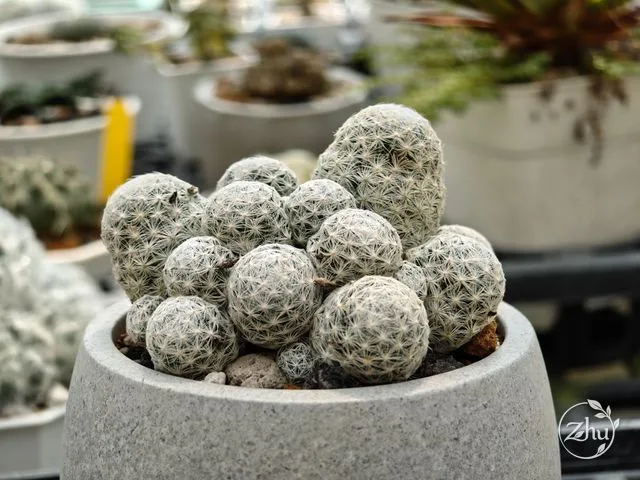
This is a cactus I'm actually quite fond of, but one I don't grow particularly well: 姬春星, in the genus Mammillaria. I originally had two pots, but one developed root rot, probably because of watering, so now only the plant in this post is in passable condition.
Also, from what I've read, there are other names on the market such as 春星 and 佛頭姬春星, which are said to differ from 姬春星 in plant size and the direction the spines grow (姬 actually just means "small"), but I haven't collected them.
Dense spines and a clumping habit
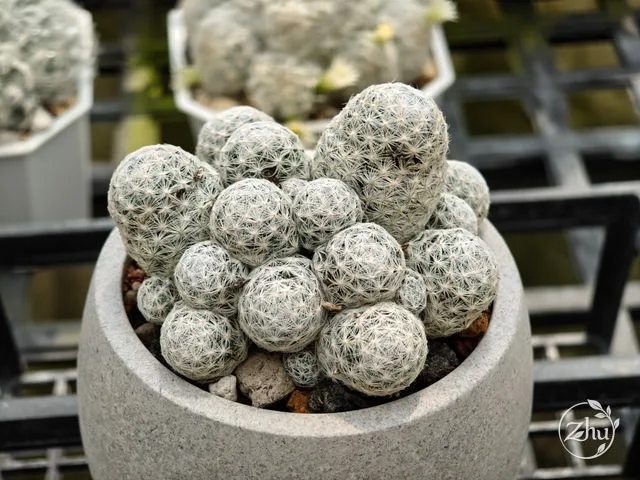
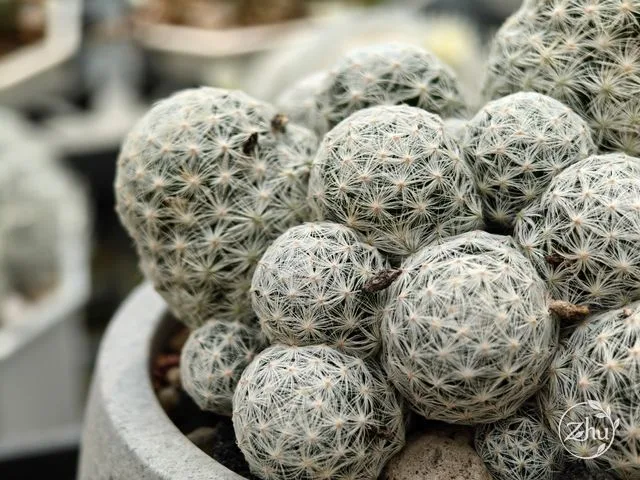
You can see that the plant is densely covered in spines, which cover almost its whole body. Anyone who collects and grows it will probably have noticed its clumping habit: offsets grow from the base of the plant, so a plant grown for many years becomes a dense, many-headed clump.
From autumn to spring it also produces small magenta-pink flowers dotted over the plant, small and lovely. If I get the chance to record them, I'll update this page.
How I grow it
I grow it under 30% shade cloth, which is a bright, diffuse-light environment, in a coarse, gritty mix with a fan for airflow. As I mentioned, my care probably isn't great, and the problem is likely the balance between watering and the mix: I water about one to two days after the surface of the soil dries, so perhaps the pot stays too humid, and that's what damaged the roots. I still need to practise and observe more.
Spines that change with growing conditions
The plant's appearance also changes with growing conditions, most obviously in its spines. With stronger light and tighter control of water, the spines become denser, until they cover almost the whole plant; with more shade and less control over watering, you'll see a more distinctly green-and-white look. So growers can adjust how they grow it to get the look they want, and enjoy that side of it.