 Zhu's Plant Journal
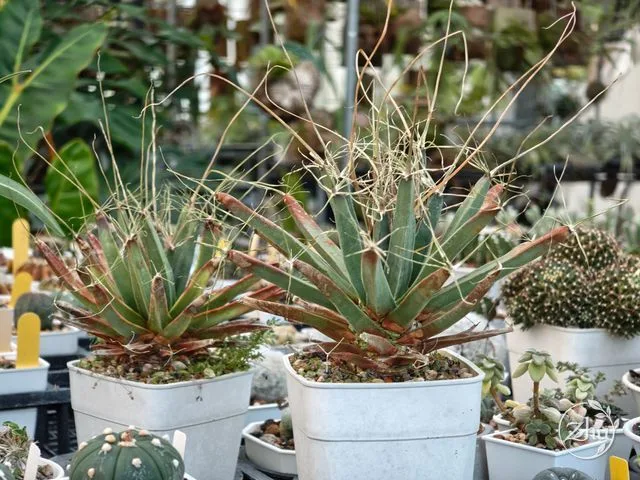
Agave cactus (Leuchtenbergia principis)
Leuchtenbergia principis Fisch. ex Hook.
Leuchtenbergia Succulents and cacti
Compiled reference
Background
This cactus belongs to the genus Leuchtenbergia in the family Cactaceae; its scientific name is Leuchtenbergia principis. The Taiwan Catalogue of Life lists its Chinese name as 龍舌仙人球 ("agave cactus") and the genus as 群戟柱屬. According to POWO, the genus contains only this one species.
It is native to north-eastern Mexico, south to Jalisco, and is a succulent subshrub growing primarily in the desert or dry shrubland biome. IUCN records it in San Luis Potosí, Durango, Tamaulipas, Nuevo León, Coahuila and Zacatecas, at 1,500 to 2,000 m, in shrubland.
Tubercles and spines
A cactus tubercle is not a leaf. The plant anatomist Mauseth explains in a 2006 review that the stem cortex below and around each areole grows outward, as a cone (a tubercle) or a ridge (a rib), carrying the areole out to its tip, which is why the spines sit at the very end of each tubercle. It is the spines that are modified leaves: in the paper's words, modified bud scales of the areole's short shoot, or equally the modified leaves of a short shoot. The foliage leaves on a cactus's vegetative shoots are microscopically small.
Flowering
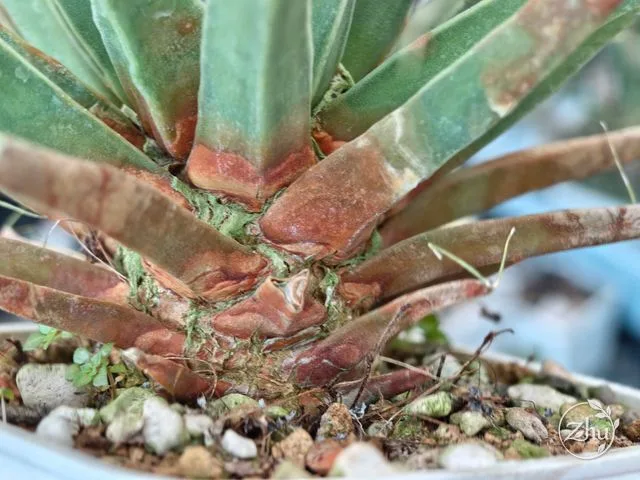
An article by the Henry Shaw Cactus and Succulent Society notes that the flowers come from the areoles at the ends of young tubercles, are yellow and 3 to 4 inches (about 7.5 to 10 cm) across, and that plants do not bloom until they are at least five years old, after which they flower sporadically from spring to autumn. The same article notes that as plants age, the lower tubercles tend to dry out and turn brown, especially at their tips.
Conservation
The IUCN Red List assessed it in 2009 (amended version published 2017) as Least Concern: the population is stable, with about 500,000 mature individuals; threats include livestock grazing and collecting. IUCN also notes that the assessment needs updating.
The entire cactus family is listed in CITES Appendix II (except species in Appendix I), and this species is included. Appendix II means international trade is regulated, not banned; it governs cross-border trade and is separate from each country's own domestic law.
Sources
- Royal Botanic Gardens, Kew — Plants of the World Online (POWO): Leuchtenbergia principis Fisch. ex Hook.
- 臺灣物種名錄 TaiCOL: Leuchtenbergia principis 龍舌仙人球
- 臺灣物種名錄 TaiCOL: Leuchtenbergia 群戟柱屬
- Mauseth, J. D. — Annals of Botany 98: 901–926(2006): Structure–Function Relationships in Highly Modified Shoots of Cactaceae
- Henry Shaw Cactus and Succulent Society(美國非營利協會)— Plants of the Month,Barbara Wedler(2008): Leuchtenbergia principis (2008)
- IUCN Red List of Threatened Species: Leuchtenbergia principis
- UNEP-WCMC/CITES 秘書處 — Species+: Leuchtenbergia principis Hooker — CITES Listings
My own observations
Cultivation
A cactus that doesn't look like one
This cactus is also known as 晃山. If you tell people it's a cactus, many won't make the connection at first glance; they'd more likely take it for an agave. At first sight it looks like a plant you really don't want to mess with, because its three-sided columns look stiff and strong.
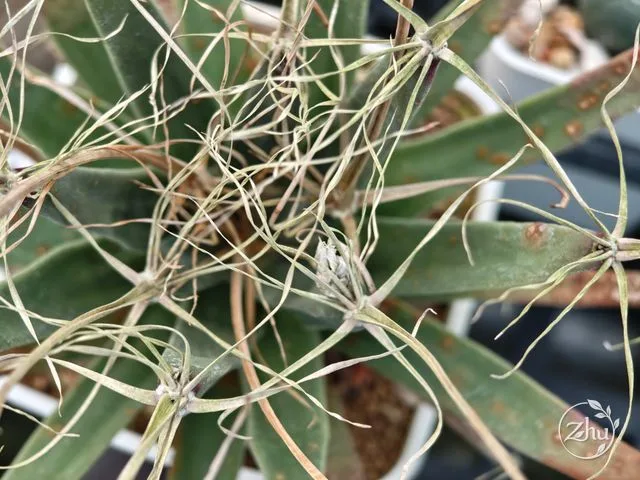
Three-sided tubercles and papery spines
Some articles call these three-sided structures tubercles. At the front of each column there are spines, very long and fierce-looking; but when you accidentally touch them, you find they're actually rather papery and soft, and don't feel like spines at all. There's wool where the segments join.
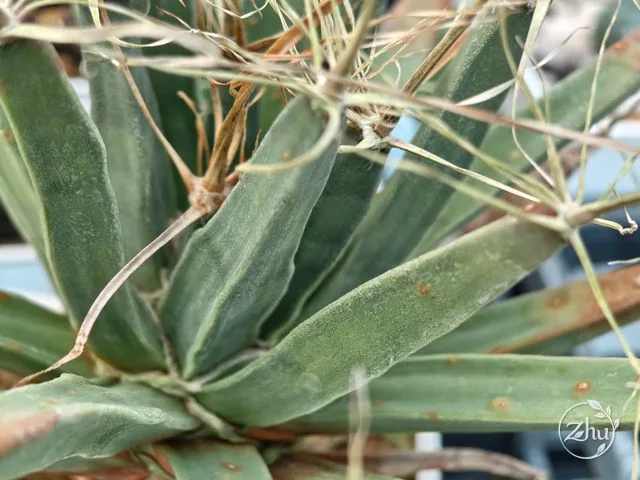
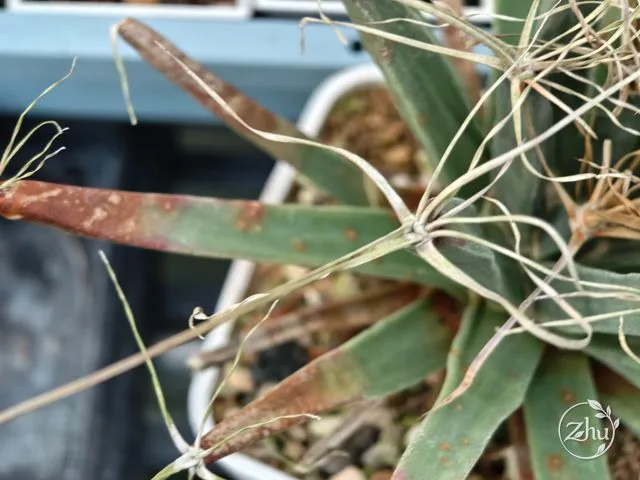
When I looked it up later, I found that the tubercles aren't leaves at all but stem tissue: the stem below each areole grows out into a column and pushes the areole out to the tip, and it's actually the spines that are modified leaves. So each of those three-sided columns is really a stretched-out piece of stem.
Mottling at the base
I've actually been growing this plant for quite a while (five or six years), and it hasn't been repotted for about three years. I'm not sure whether it's because conditions have been harsher lately, with longer hours of strong, direct sun, that the base has developed some patchy, mottled areas, or whether repotting will help; or whether it picked up some pathogen at some point, though the plant doesn't look damaged anywhere. The mottling is all on the older, more mature parts.
How I grow it
It has a really wild look and a very tough appearance, and it's genuinely not difficult to grow, much like an ordinary cactus: it grows slowly and tolerates drought and strong sun. I grow it in a coarse, gritty mix with good airflow; for watering, waiting two or three days after the mix dries out works fine.
Still waiting to see it flower
The one disappointment is that I still haven't seen it flower. I feel that after all this time it ought to. When I took it over it was in a 3-inch pot. I don't know whether its flowers are so short-lived that I missed them, since I once noticed a flake of dried brown material on the plant but couldn't be sure what it was, or whether it simply isn't mature enough yet. I hope I'll be able to photograph it in flower later.