 Zhu's Plant Journal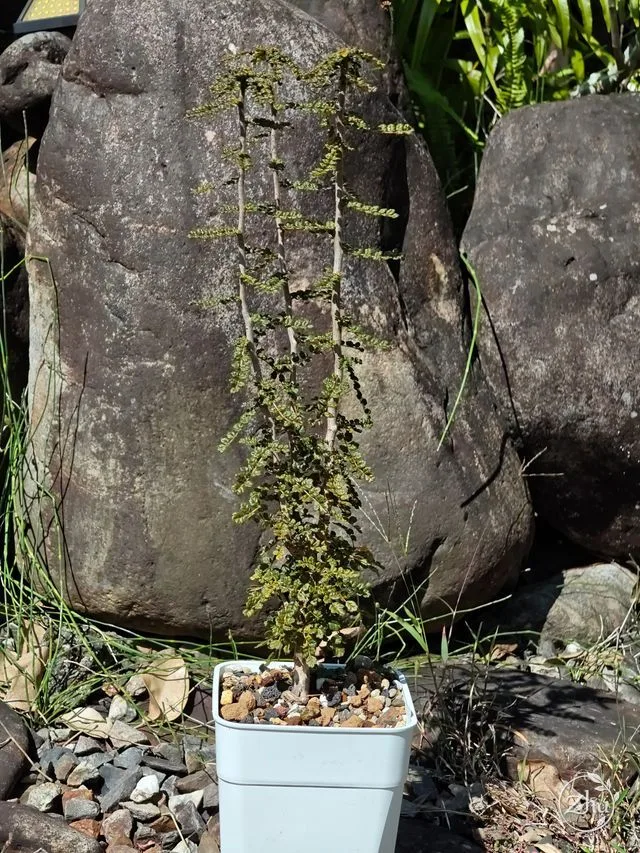
Compiled reference
Background
This plant belongs to the genus Commiphora in the family Burseraceae. Its scientific name is Commiphora planifrons.
It is a shrub or tree native to the island of Socotra, Yemen, growing primarily in the desert or dry shrubland biome; IUCN records its habitat as forest and shrubland.
The IUCN Red List assessed it as Near Threatened in 2004, with an unknown population trend; the threats listed are the gathering of plants and drought. The assessment is now more than 20 years old, and IUCN notes that it needs updating.
It is not listed in the CITES Appendices.
Sources
- Royal Botanic Gardens, Kew — Plants of the World Online (POWO): Commiphora planifrons (Balf.f.) Engl.
- IUCN — The IUCN Red List of Threatened Species: Miller, A. 2004. Commiphora planifrons. e.T30417A9547043
- UNEP-WCMC/CITES 秘書處 — Species+: Commiphora — 查詢
My own observations
Cultivation
Name and leaves
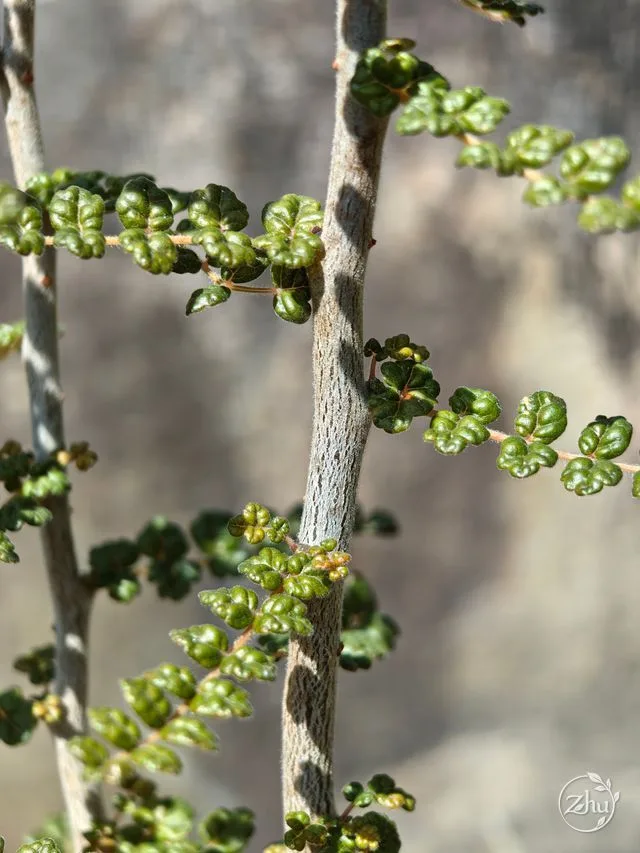
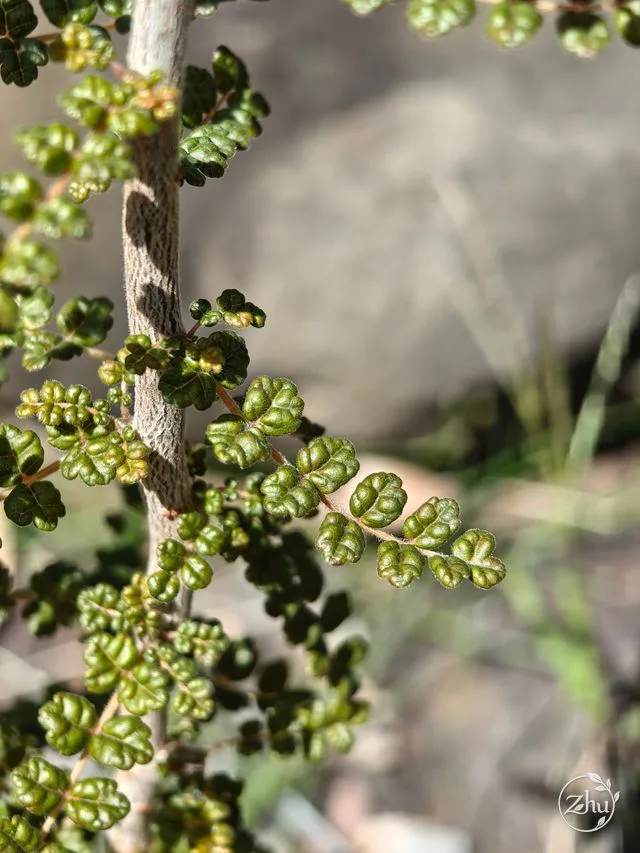
Among the Commiphora, this one has a really distinctive leaf. Its Chinese name, 泡泡葉沒藥 ("bubble-leaf myrrh"), says it all: the leaves are small, and their surface is covered in clear oval to round bumps, which makes the name very fitting. The leaves are once-pinnate.
Stems and air layering
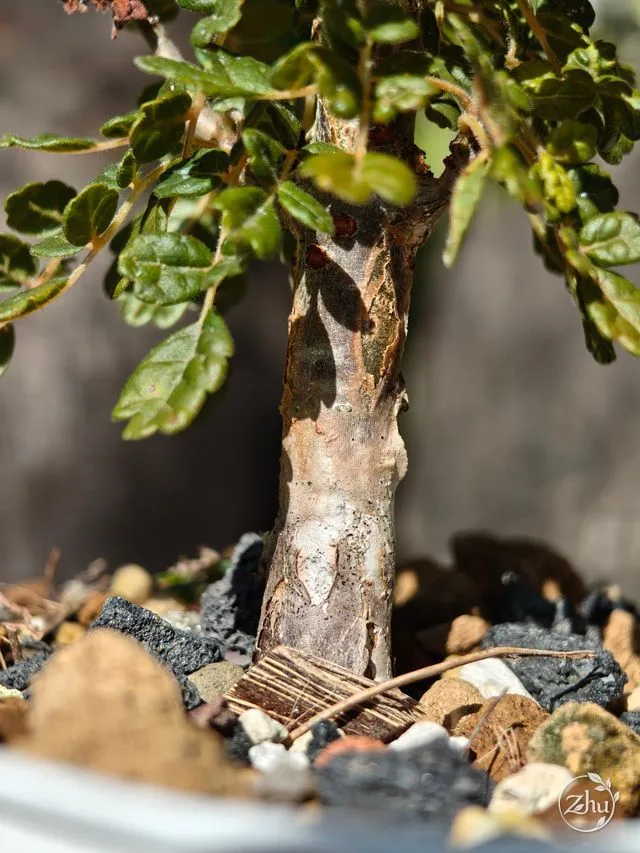
As for the plant's overall form, in my experience its stems don't thicken easily. I have three to five seed-grown plants, about two to three years old, and before dormancy, in autumn and winter, the stems don't swell as noticeably as in other Commiphora.
That makes air layering (removing a ring of bark on a branch and wrapping it in media until it roots, then cutting it off to pot up) comparatively tricky, I think. The stems are rather thin, so I worry about accidentally snapping a stem while wrapping the media around it, or the wrapped media being heavy enough to bend the stem until it breaks.
In practice, though, it isn't hard to propagate. The success rate for air layering is reasonable, and more and more vegetatively propagated plants are appearing on the market. Side shoots also come through well afterwards: once a branch with a dominant tip is cut, new side shoots readily appear from the nodes below, so new branches are easy to get.
Growing
Overall, I find it quite easy to look after. As with the other plants I've written about, I use coarse media, good ventilation and plenty of light, and it generally does well. In full sun the leaves take on a slightly coppery tone and develop a noticeable cuticle, giving them a faint sheen.
Bonsai potential
Compared with other Commiphora, I feel it has a bit less potential as a bonsai subject, because its branches tend to keep shooting upward rather than branching horizontally. If you want to bend it sideways, I worry the stems aren't flexible enough. Perhaps once I have a good number of vegetatively propagated plants, I'll test this more thoroughly.