 Zhu's Plant Journal
 2026-10-04 Flowering and fruiting
Podocarpus seeds and their receptacles
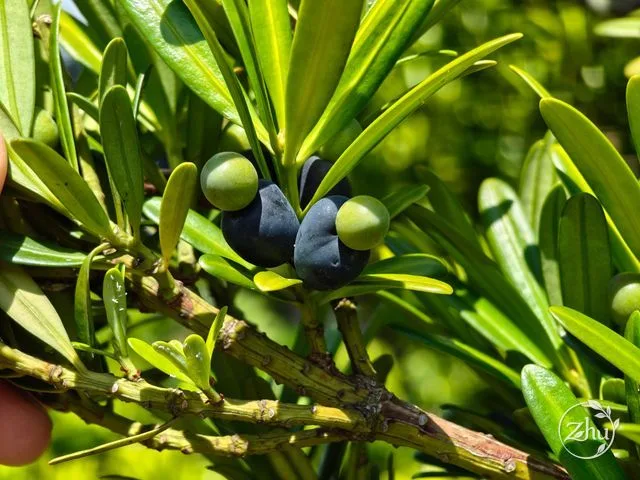
In late summer and early autumn, developing seeds start to appear on the branch tips of my Podocarpus. What people usually call the "fruit" is actually a seed, and the fleshy part beneath it is the receptacle; together they look like a monk in a robe.
This post simply records how the seeds of my Podocarpus (羅漢松, "arhat pine") were developing. What people usually call the fruit is actually a seed.
Around late summer and early autumn, developing seeds began to appear on the branch tips. The reason it's called 羅漢松 is that as the seed develops, there is a structure called the receptacle, with the developing seed on top, and the whole thing looks like an arhat (a Buddhist monk) wearing a robe, which is how it got its name.
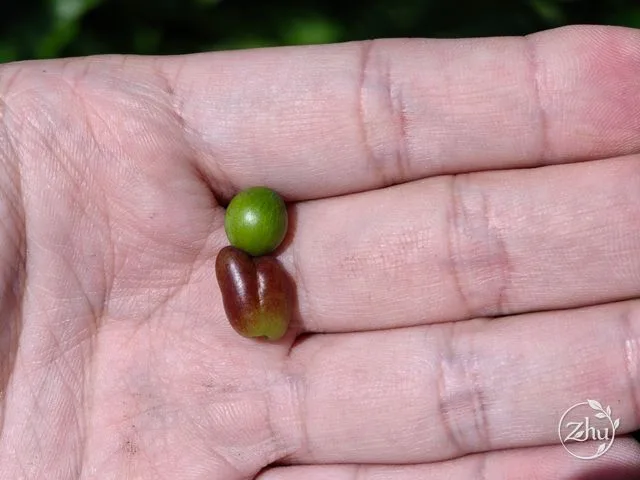
Since I happened to catch this process, I recorded how they developed.
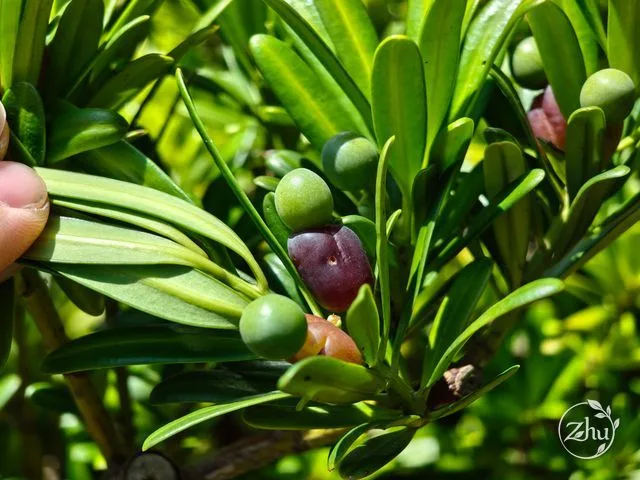
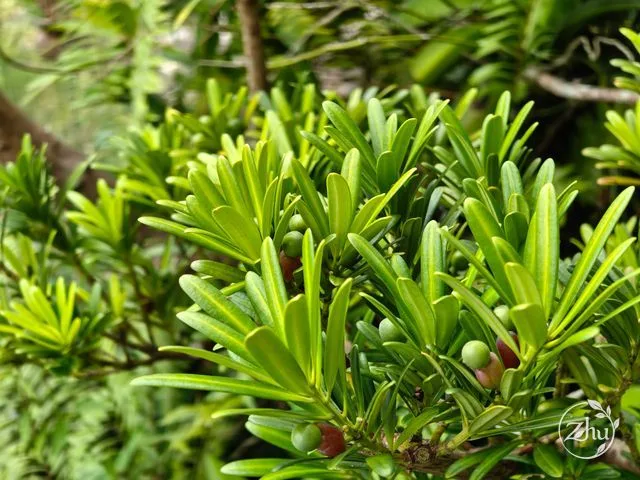
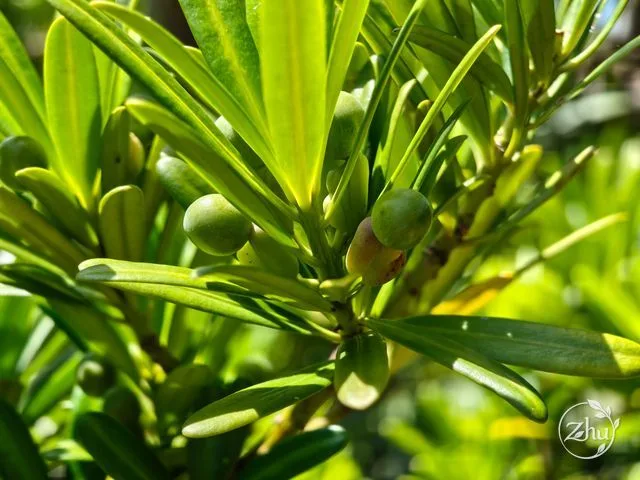
Also, when I looked it up, I found that the seed is toxic and not edible, but the receptacle is. "Edible" here probably doesn't mean it's used as ordinary food, just that it can be eaten. In fact, when the receptacles had turned purple-red, I really did take a small bite. It was firm but slightly sticky and fleshy, with a sweet taste, and I imagine many birds would love it.
In the future, if I have time, I'll probably collect some seeds and try sowing them to see how they germinate, and share anything I learn.
A seed, not a fruit
When I looked it up, I found that Podocarpus is a gymnosperm, so it doesn't form a true fruit. The round part is a seed wrapped in a layer called the epimatium, which turns purplish black with a white bloom when ripe; the fleshy part beneath it is the receptacle, which turns red to purple-red when ripe and is longer than the seed. Since there's no fruit, there's no such thing as a "fruit receptacle" either. Part of the reason there are so many different versions online is that many English sources call the receptacle an "aril", or even simply a "fruit", and it gets even more muddled once translated into Chinese.
Compiled reference
Sources
- Flora of China Editorial Committee — Flora of China(eFloras.org): Podocarpus macrophyllus (Thunberg) Sweet(Flora of China Vol. 4, Podocarpaceae)
- 中國科學院植物研究所 — iPlant 植物智: 罗汉松 Podocarpus macrophyllus
- 香港特別行政區政府 — 綠化網(greening.gov.hk)二維條碼樹木標籤: 羅漢松 Podocarpus macrophyllus (Thunb.) Sweet
- North Carolina State University/N.C. Cooperative Extension — Extension Gardener Plant Toolbox: Podocarpus macrophyllus