 Zhu's Plant Journal
 2026-09-17 Flowering and fruiting
The crown of thorns my mum brought home
A crown of thorns my mum brought home from a garden shop and planted in our garden. It has been in full bloom the whole time, so I photographed it.
This crown of thorns isn't actually one I grew. My mum brought it home from a garden shop one day and has had it planted in our garden for a while. I noticed it has been in full bloom the whole time, so I took photos to record it.
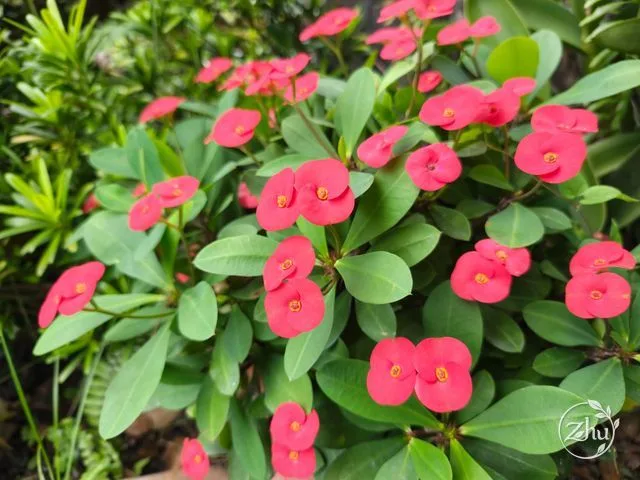
I once heard a professor in my university department talk about the crown of thorns, a plant in the spurge family, Euphorbiaceae: it is a very popular flowering crop in that family. The most famous member of its family, of course, is the poinsettia.
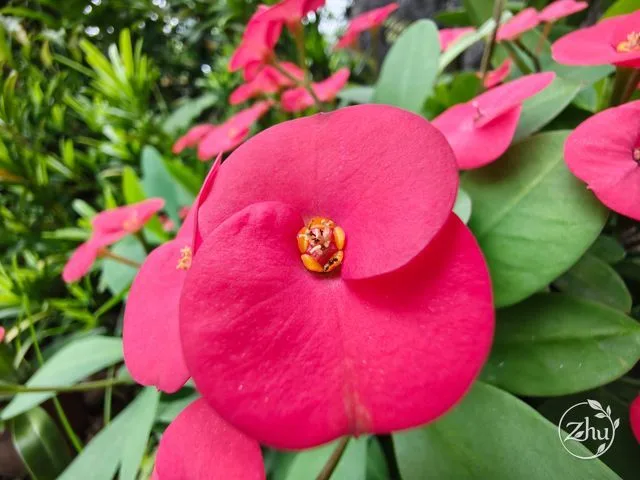
Just like the poinsettia, the bright red parts of the crown of thorns are not its main petals but its bracts. The real flowers are only in the yellow area in the middle, and that area is a rather special inflorescence called a cyathium.
The crown of thorns has been sold as a commercial potted flower for a long time. Through that long history of commercial growing and trade, and with today's breeding techniques, there are more and more varieties with soft spines or almost no spines, instead of the hard spines the wild species carries.
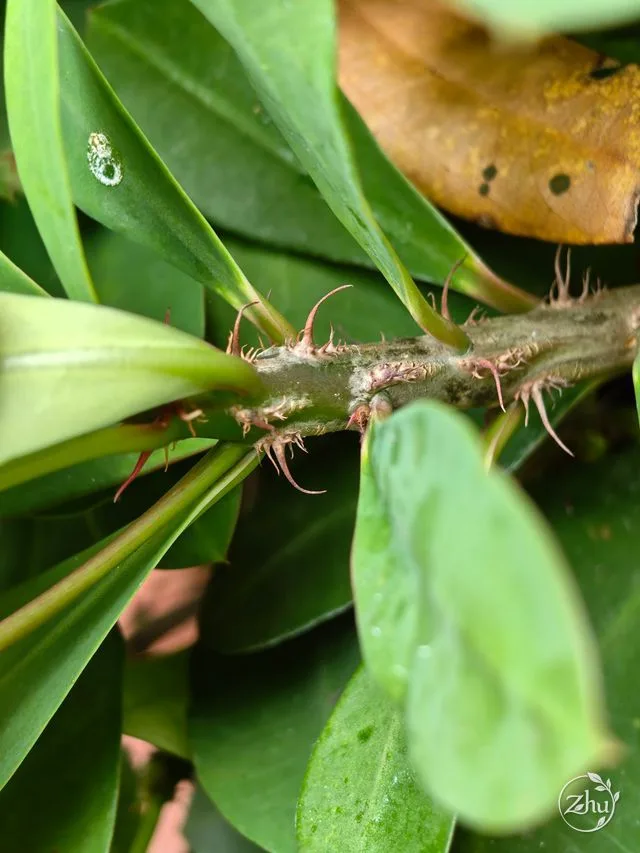
You can see the spines on the plant at home aren't very stiff or straight. They actually feel soft to the touch.
I'm not sure what variety our plant is. I know it may include Euphorbia milii, but it could also be a hybrid with Euphorbia geroldii, so here I only go as far as the genus (Euphorbia spp.).
This post is mainly a record: photos of beautiful flowers I came across close to home.
About the crown of thorns
The following is researched information.
- Name and native range: Euphorbia milii is in the spurge family, Euphorbiaceae. It is native to Madagascar, and one of its English common names is crown of thorns.
- The cyathium: The inflorescence of Euphorbia is called a cyathium, and it looks like a single flower. On the outside is a bowl-shaped to tubular involucre enclosing several clusters of male flowers and one central female flower. Each male flower is reduced to a single stamen, and the female flower to a single ovary. Glands sit on the rim of the involucre, and in some species they carry petal-like appendages.
- The red parts are bracts: Each crown of thorns cyathium sits above 2 kidney-shaped to round bracts, usually bright red, and pink, white or yellow in some cultivars. The glands in the middle are yellowish red. In the poinsettia (Euphorbia pulcherrima), the cyathia are surrounded by 5 to 7 leaf-like scarlet bracts.
- Spines: According to the Flora of China, the stems of the crown of thorns are densely spiny, and the spines are modified stipules.
- Importance in horticulture: The Flora of China notes that the poinsettia and the crown of thorns are extremely important in the horticultural trade.
- Careful with the sap: Euphorbia plants contain latex throughout, usually white. North Carolina State University Extension recommends wearing gloves when handling crown of thorns to prevent skin and eye irritation from the sap. It is toxic if eaten, so keep it out of reach of small children and pets.
Compiled reference
Sources
- 臺灣物種名錄 TaiCOL: Euphorbia milii 麒麟花
- Flora of China Editorial Committee — Flora of China, Vol. 11(eFloras): Euphorbia Linnaeus 大戟屬
- Flora of China Editorial Committee — Flora of China, Vol. 11(eFloras): Euphorbia milii Des Moulins 铁海棠
- Flora of China Editorial Committee — Flora of China, Vol. 11(eFloras): Euphorbia pulcherrima Willdenow ex Klotzsch 一品红
- North Carolina State University Extension — Extension Gardener Plant Toolbox: Euphorbia milii (Crown of Thorns)
- Royal Botanic Gardens, Kew — Plants of the World Online (POWO): Euphorbia geroldii Rauh